
Carrom Tournament Software with ICF-Accurate Board Scoring
Live Results for Singles, Doubles, Club Leagues and Federation Events
In carrom the winner of a board scores one point for each of the opponent's carrom men still on the board, plus three points for the queen if they covered it — up to a maximum of twelve points per board. The queen stops counting for a player who has already reached 22 points. A game is won at 25 points or after eight boards, whichever comes first, and a match is best of three games.
JudgeMate for Carrom
Everything runs in the browser — phone, tablet or laptop, nothing to install.
Set up an event
Categories, scoring and live results in one dashboard. Sign in to start.
Open a carrom board
Free, no account. Share the spectator link and show the board on a big screen.
Guides for this sport
3 guides on rules, scoring and running a competition
What JudgeMate Does for Carrom
Board-by-board scoring, draws and league tables built on the ICF numbers
Carrom did not need another counter app. It needed a scorer that knows what a board is worth.
Board result, not point taps
Record the winner, the opponent's remaining men and the queen. The platform works out the points — including the rule that the queen stops counting at 22.
Games that close themselves
25 points ends the game immediately. So does the eighth board, with the game going to whoever leads. A level score after eight sends you to an extra board, exactly as the Laws require.
Singles and doubles from one draw
Switch the entry mode and the same tournament runs for individuals or pairs. Round robin, knockout and groups-into-knockout are all available.
League table with board points
Games won decide the order, board points separate ties. No draws column, because carrom matches cannot be drawn.
Live on any screen
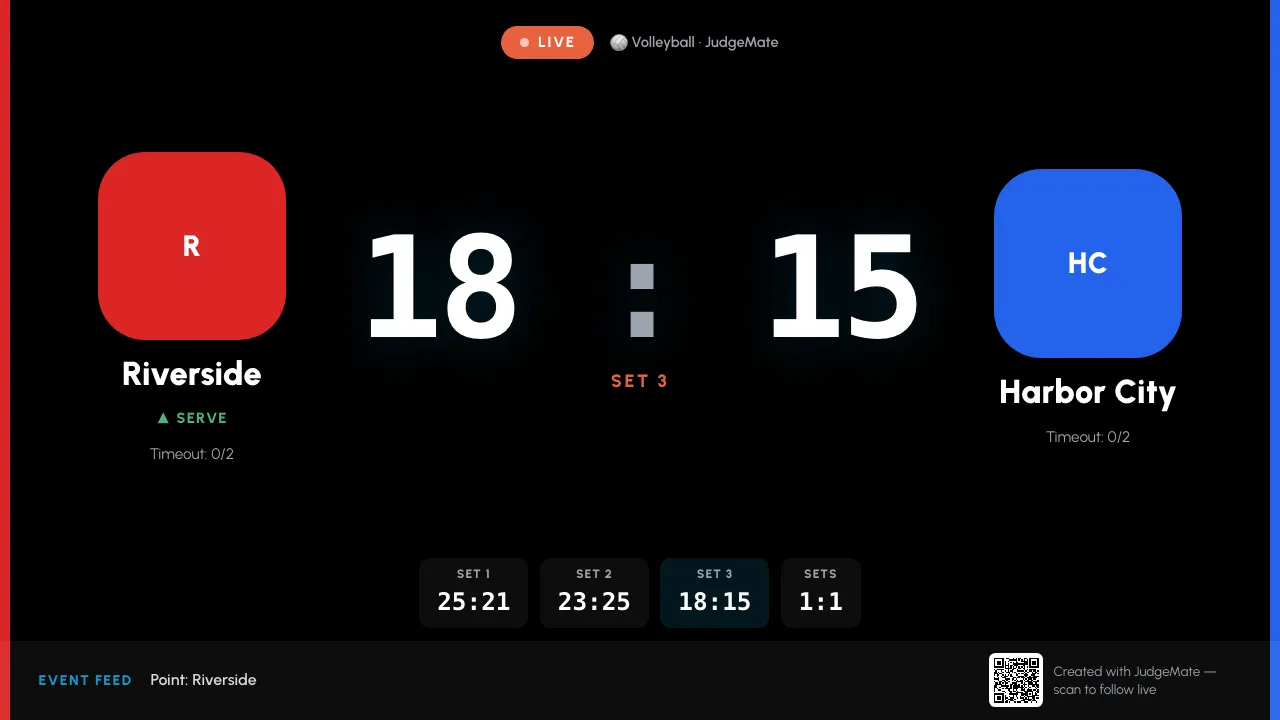
Share a link or a QR code. Spectators see the running game, the board counter and who breaks next — no account, no app.
Tables and time slots
Assign matches to numbered tables and time slots, with clash detection so no player is scheduled on two boards at once.
Audience polls
Run a live vote during the event — shot of the tournament, player of the night — with results updating on the same screen as the scores.
Groups, a knockout, or doubles that rotate
A club tournament runs as a round robin, as a knockout, or as groups into a knockout with a consolation plate. Set the category to doubles — the ICF format — and the rotating rounds open up, so a social evening pairs players differently every round.
Entries, a place limit and a waiting list
Players sign up from the public event page. The cap matches the number of boards you have; past it, entries queue on the waiting list and you promote them by hand. Entry fees are recorded as paid, waived or unpaid, with a running total.
3 more features
Audience polls
Run a live vote during the event — shot of the tournament, player of the night — with results updating on the same screen as the scores.
Groups, a knockout, or doubles that rotate
A club tournament runs as a round robin, as a knockout, or as groups into a knockout with a consolation plate. Set the category to doubles — the ICF format — and the rotating rounds open up, so a social evening pairs players differently every round.
Entries, a place limit and a waiting list
Players sign up from the public event page. The cap matches the number of boards you have; past it, entries queue on the waiting list and you promote them by hand. Entry fees are recorded as paid, waived or unpaid, with a running total.
Carrom Competition Formats
How Carrom Events Are Played
SinglesOne player against one, seated opposite each other. Boards alternate the break, and the player who breaks plays the white men for that board (ICF Law 43). A game runs to 25 points or eight boards; the match is best of three games. JudgeMate models singles as a draw of individual entrants — round robin, knockout, or groups feeding a knockout.
One player against one, seated opposite each other. Boards alternate the break, and the player who breaks plays the white men for that board (ICF Law 43). A game runs to 25 points or eight boards; the match is best of three games. JudgeMate models singles as a draw of individual entrants — round robin, knockout, or groups feeding a knockout.
DoublesFour players, partners seated opposite each other so that play passes to the right-hand player each turn (ICF Laws 28 and 49b). The scoring is identical to singles — the same board values, the same 25-point game, the same best of three. In JudgeMate doubles is the same draw with the entry mode switched to pairs, and the board picks the change up automatically.
Four players, partners seated opposite each other so that play passes to the right-hand player each turn (ICF Laws 28 and 49b). The scoring is identical to singles — the same board values, the same 25-point game, the same best of three. In JudgeMate doubles is the same draw with the entry mode switched to pairs, and the board picks the change up automatically.
Club LeagueThe format most clubs actually run: a season of individual matches with a table underneath. Because carrom cannot be drawn — a level score after the eighth board sends you to an extra board under Law 56b — the table has no draws column. JudgeMate ranks on games won and uses board points as the separator, which is the natural tie-break for the sport rather than an imported one.
The format most clubs actually run: a season of individual matches with a table underneath. Because carrom cannot be drawn — a level score after the eighth board sends you to an extra board under Law 56b — the table has no draws column. JudgeMate ranks on games won and uses board points as the separator, which is the natural tie-break for the sport rather than an imported one.
Swiss LeagueFederation events frequently pair players by running score rather than by a fixed bracket, so strong players meet late and nobody is knocked out after one bad board. JudgeMate covers this shape with round-robin and group formats plus a live table; the pairing itself stays with the tournament director.
Federation events frequently pair players by running score rather than by a fixed bracket, so strong players meet late and nobody is knocked out after one bad board. JudgeMate covers this shape with round-robin and group formats plus a live table; the pairing itself stays with the tournament director.
How Carrom Is Scored
Carrom has no judging panel. A board is a fact, not an opinion: someone pockets all nine of their men first, and what the board is worth follows from what is left on the surface. The scorer records the facts and the arithmetic follows.
- boardWinner
- Which side cleared their nine men first — the winner of the board (Law 52a).
- menRemaining
- How many of the opponent's men are still on the board, from zero to nine. Each one is a point for the winner (Law 53a).
- queenCovered
- Whether the winner pocketed and covered the queen. Worth three points, but only while that player is on 21 points or fewer (Laws 52b and 54).
- boardNumber
- Which board of the game this is. The eighth board ends the game, and the leader takes it (Law 56a).
The scorer taps the side that won the board, picks how many of the opponent's men are left on a 0-9 grid, and marks the queen if it was covered. The engine applies the 22-point queen cut-off, caps the board at twelve, closes the game at 25 points or after the eighth board, and sends a level score after eight boards to an extra board. The running score, the board counter and the break indicator appear on the spectator view and on the venue screen at the same time. Every board is a single entry on the match timeline, so an incorrect board is undone in one tap rather than unpicked point by point.
Guides and tools about Carrom
- How Carrom Is ScoredA board is worth the opponent's remaining men plus three for the queen, capped at twelve. Games run to 25 points or eight boards. Worked example included.
- Carrom Fouls and PenaltiesTechnical foul, foul and the Due explained: what each costs, when you keep your turn, and the queen rules that can lose you the board outright.
- How to Organise a Carrom TournamentPick a format, work out how many boards and hours you need, check the boards, and run the scoring. A practical guide for club and federation events.
Carrom Scoring: Frequently Asked Questions
Sources
- Laws of Carrom — Indian Carrom Federation
- Laws of Carrom (ICF) — Malaysian Carrom Association
- About Carrom — International Carrom Federation
More about Carrom
6 sections · Carrom: A Sport Where Every Board Is Worth a Different Number · Major Carrom Competitions · Carrom Players Who Shaped the Sport · Carrom Equipment and Board Standards · Where Competitive Carrom Is Going · How Carrom Became a Codified Sport
More about Carrom
6 sections · Carrom: A Sport Where Every Board Is Worth a Different Number · Major Carrom Competitions · Carrom Players Who Shaped the Sport · Carrom Equipment and Board Standards · Where Competitive Carrom Is Going · How Carrom Became a Codified Sport
Carrom: A Sport Where Every Board Is Worth a Different Number
Most scoring software assumes a point is a point. Carrom does not work that way. A board ends when one player pockets all nine of their men, and only then does anyone find out what it was worth — one point if the opponent was a single man from finishing, twelve if they never got going and the queen was covered. The scorer's job is not to tap a counter; it is to read the board and record a result.
That is also why the queen rule catches people out. Under ICF Law 54 the queen carries three points, but only while the winner is on 21 points or fewer. Cross 22 and it is worth nothing to you for the rest of that game. It is a small rule with a large consequence, and it is exactly the kind of thing a paper scoresheet gets wrong at the end of a long evening.
JudgeMate puts that arithmetic in the engine instead of in the scorer's head. You record what happened on the board — who cleared, how many men were left, whether the queen was covered — and the platform works out the points, closes the game at 25 or after the eighth board, and pushes the result into the draw and the league table.
Major Carrom Competitions
Carrom's international calendar is run by the ICF and its continental confederations, with national championships feeding into it.
World Carrom Championship
The ICF's flagship title event, first held in Delhi in 1991 and since staged in Colombo, Cannes, Birmingham and Langkawi, Malaysia, in 2022. Singles, doubles and team titles for men and women.
Carrom World Cup
The ICF's other global series. The sixth edition ran in Milpitas, California, from 10 to 16 November 2024 with 17 countries and roughly 150 players; the seventh was held in the Maldives in December 2025.
ICF Cup
An international open run under ICF auspices, reaching its eighth edition in 2019. A regular route for players from smaller federations to meet the top ranks.
Eurocup
Held every summer since 1997 and rotated around European cities — Berlin, Paris, Rome and Prague among them — under the European Carrom Confederation.
National Championships
The backbone of the sport. India and Sri Lanka run the deepest fields, while national bodies across Europe, the Americas and East Asia select their Eurocup and World Cup entries this way.
Carrom Players Who Shaped the Sport
Carrom's honours list is dominated by India and Sri Lanka, though the World Cup field now spans 17 countries.
All-Time Greats
A. Maria Irudayam
India. Won the men's singles and doubles titles at the first World Carrom Championship in Delhi in 1991, the tournament that turned the newly written Laws of Carrom into a competitive standard.
R. M. Shankara
India. World Champion in 2000 in Delhi, from the generation that carried the sport through its first decade of codified international play.
Rashmi Kumari
India. Women's singles world champion in 2000, 2012 and 2022 — three titles spanning more than two decades and almost the entire modern history of the championship.
Nishantha Fernando
Sri Lanka. Men's singles world champion at the 2012 championship in Colombo, and one of the strongest arguments that carrom's centre of gravity was never only in India.
K. Srinivas
India. Won the sixth Carrom World Cup in Milpitas, California, in November 2024, taking multiple golds at a tournament that drew 17 countries.
Current Elite
Khazima Mahabooba Basha
India. Won the women's title at the 2024 Carrom World Cup in California at seventeen, sweeping gold in singles, doubles and team and beating reigning world champion Rashmi Kumari on the way.
Srinivas Komaravelli
India. Men's champion of the sixth Carrom World Cup, 2024, a tournament played over a week with 150 players in the draw.
Kajal Kumari
India. At the 2018 World Cup she became the first woman to win the overall combined Swiss League title, and remains a fixture in Indian national squads.
Chamil Cooray
Sri Lanka. A long-standing presence at the top of international draws and a former Swiss League champion at World Cup level.
Yogesh Pardeshi
India. Known for striker control and shot execution, and a regular in the closing rounds of Indian national events.
Carrom Equipment and Board Standards
Carrom is unusually sensitive to equipment. The same shot is on or off depending on how fast the surface runs, which is why the ICF specifies not just dimensions but how far a striker must travel. Tournament boards are checked before play, and a board that fails the speed test is not used.
The board
The playing surface is a square between 73.50 cm and 74 cm, on plywood or an equally smooth wood at least 8 mm thick, with a pocket at each corner. Boards are mounted level and lit evenly — a shadow across one corner changes what a player can see.
Surface speed
An ICF board must let a normally smooth 15 g striker run at least three and a half lengths from a base line to the opposite frame when struck at full force. It is a practical test of whether the surface is fast enough for tournament play.
Carrom men
Nine white, nine black and one red queen. Each man is between 3.02 cm and 3.18 cm across and weighs between 5.25 g and 5.50 g, so a set that has been mixed from two boxes is usually detectable by feel.
The striker
Larger and heavier than the men: up to 4.13 cm across and up to 15 g. Players are particular about strikers in the way snooker players are about cues, and most bring their own.
Boric powder
A fine powder dusted over the surface to reduce friction. How much to apply, and when to re-dust mid-game, is a genuine tactical question rather than housekeeping.
Where Competitive Carrom Is Going
Three shifts are visible in the current calendar: the field is widening, the sport is younger at the top, and the club league is becoming the main unit of organised play.
A wider international field
The 2024 World Cup in California drew 17 countries and around 150 players, and the ICF's membership now includes European, East Asian and North American associations alongside the traditional South Asian powers. Hosting has followed: Cannes in 2008, California in 2024, the Maldives in 2025.
Younger champions
Khazima Mahabooba Basha won the 2024 World Cup women's title at seventeen, beating a three-time world champion on the way. Where national associations run school and junior programmes, the gap between a first national final and an international title is closing.
Clubs organising around leagues
Outside South Asia the sport runs on weekly club evenings rather than large annual tournaments, which makes the standing table — not the bracket — the thing players follow. That is a scheduling and record-keeping problem more than a scoring one, and it is where most clubs still rely on spreadsheets.
Scoring moving off paper
Board-by-board arithmetic with a conditional queen rule is exactly the kind of task that goes wrong late in an evening. Digital scoring removes the arithmetic, keeps a per-board record that can be corrected, and puts the running score on a screen the whole room can see.
How Carrom Became a Codified Sport
From Parlour Game to Competition (early 20th century)
Carrom spread across South Asia as a household game long before anyone wrote down what a board was worth. Boards were made locally, sizes varied, and house rules decided whether the queen counted three points or five, whether it had to be covered, and how many boards made a game. Two clubs could play each other all evening and disagree about the score at the end.
Organised competition arrived with national associations, first in India and Sri Lanka, which pushed the game towards a single set of numbers. Standardising the board itself mattered as much as standardising the scoring: a slower or faster surface changes which shots are possible, so a national title meant little if the boards were not comparable.
The International Carrom Federation (1988)
On 15 October 1988 delegates from India, Sri Lanka, the Maldives, Malaysia, Germany and Switzerland met in Madras for the first World Carrom Congress and founded the International Carrom Federation. The ICF is based in Zürich and, as of November 2024, had 19 member associations.
The federation's first job was the one the sport most needed: a single rulebook. The Laws of Carrom were adopted after detailed debate at the second ICF Congress in 1991 in Malé, Maldives, and they settled the questions that house rules had answered differently for decades — the queen at three points, a ceiling of twelve points per board, and a game of 25 points or eight boards, whichever comes first.
World Championships and World Cups (1991 onwards)
The first World Carrom Championship was held in Delhi in 1991, where A. Maria Irudayam took the men's singles and doubles titles. Later editions went to Colombo in 1995, Delhi again in 2000 — won by R. M. Shankara — Colombo in 2004, Cannes in 2008, Colombo in 2012, where Sri Lanka's Nishantha Fernando took the men's title, Birmingham in 2016 and Langkawi, Malaysia, in 2022.
Alongside the Championship, the ICF runs a World Cup series. The sixth edition was played in Milpitas, California, from 10 to 16 November 2024, hosted by the United States Carrom Association with 17 countries and around 150 players; the seventh followed in the Maldives in December 2025. Rashmi Kumari's women's singles world titles in 2000, 2012 and 2022 span almost the whole modern era of the sport.
Carrom Outside Asia (1997 onwards)
Europe has had its own competition calendar since 1997, when the Eurocup began rotating around European cities — Berlin, Paris, Rome and Prague among them — coordinated by the European Carrom Confederation. The ICF's member list now runs well beyond South Asia, taking in the Czech Republic, France, Germany, Great Britain, Italy, Japan, Korea, Poland, Spain, Sweden, Switzerland and the United States.
The pattern outside Asia is club-driven rather than school-driven: a handful of committed clubs run weekly evenings and a national ranking, and the national body sends whoever qualifies to the Eurocup or the World Cup. That structure — many small events, one running table — is what makes carrom a league sport as much as a tournament sport.
Run Your Carrom Event on JudgeMate
Set up a tournament or a club season, invite the players, and score board by board. Free for organisers, free for spectators.
No card, no trial period, no per-player fee.