
Football scoreboard, free, from your phone
Sunday league, youth tournaments, amateur cups
At grassroots level, where VAR and goal-line technology aren't available, accurate score tracking becomes even more important. JudgeMate's Free Scoreboard logs every goal, card, and period change in real time, giving grassroots football the scoreboard it needs.
JudgeMate for Football
Everything runs in the browser — phone, tablet or laptop, nothing to install.
Start a football scoreboard
Free, no account. Share the spectator link and show the board on a big screen.
Guides for this sport
13 guides on rules, scoring and running a competition
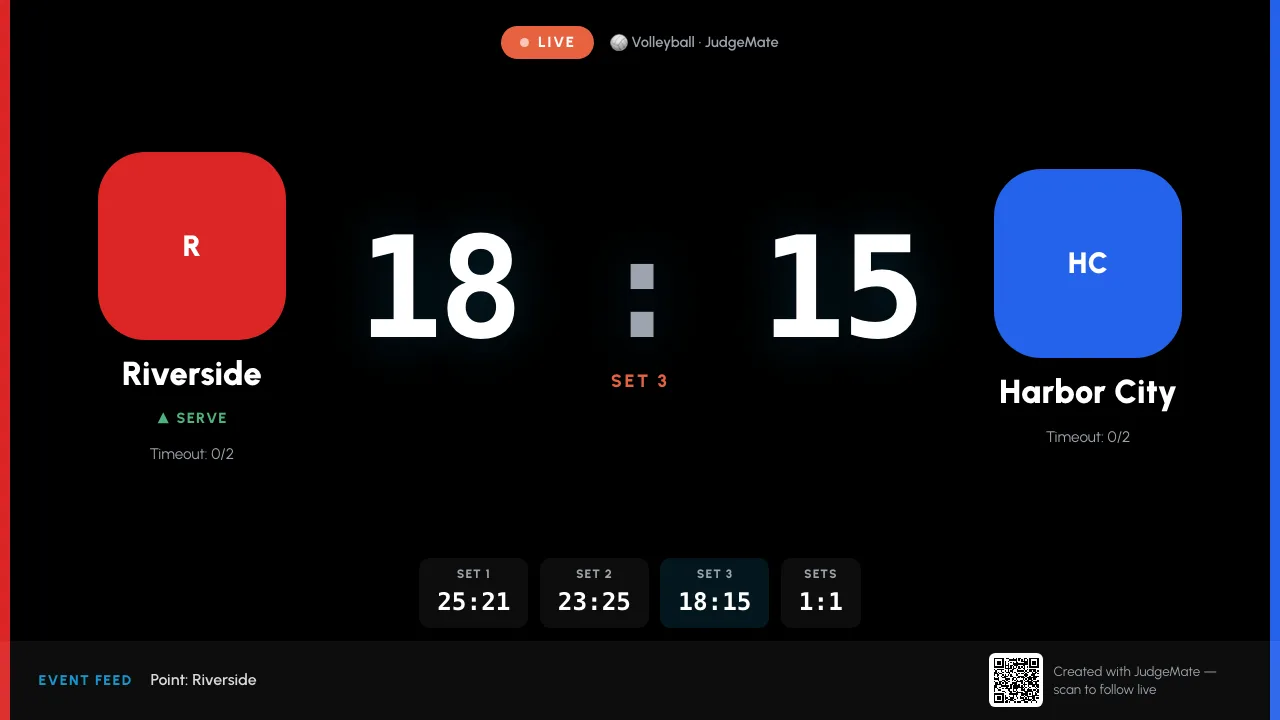
JudgeMate for football matches
A scoreboard that matches how football is played
One phone runs the match. Goals, cards, clock, and stoppage time sync to every spectator screen on a shared link.
No sign-up
Open JudgeMate, pick Football, type the team names, and the match is live. No account, no trial, no fees. The admin controls from a phone; spectators follow the same link on any device.
Live sync to every screen
Goals update everywhere the link is open — parents' phones, tournament LCDs, clubhouse TVs. Organizers running several pitches at once can share one link per pitch.
Stoppage time display
When the clock passes 45 or 90 minutes, the display switches to 45+01:00 with a red stoppage indicator, the way broadcast shows it. The clock runs cumulatively through extra time (90→105→120).
Yellow and red cards
Log cards with a player number. Second yellows on the same player are highlighted. The spectator display shows the full card log for the match.
Penalty shootout
When a knockout match goes to penalties, the scoreboard switches to shootout tracking — round-by-round attempts, running tally, sudden death.
Built for big displays
High-contrast colors, large fonts, clean layout. Plug a laptop into a projector or a clubhouse TV and the spectator view scales to fit.
Match-day polls
Open quick polls during the match — MVP, best save, player of the match. Fans vote from their phones, the leaderboard moves in real time, and the archive shows what the crowd thought after every game.
1 more feature
Match-day polls
Open quick polls during the match — MVP, best save, player of the match. Fans vote from their phones, the leaderboard moves in real time, and the archive shows what the crowd thought after every game.
Football Competition Formats, Refereeing & Rules
Competition Formats
11-a-Side Football (Association Football)The standard format of football, played on a full-size pitch (100-110m x 64-75m) with two teams of 11 players. Matches consist of two 45-minute halves with a 15-minute half-time break. The referee may add stoppage time at the end of each half to compensate for injuries, substitutions, and other delays.
The standard format of football, played on a full-size pitch (100-110m x 64-75m) with two teams of 11 players. Matches consist of two 45-minute halves with a 15-minute half-time break. The referee may add stoppage time at the end of each half to compensate for injuries, substitutions, and other delays.
In knockout competitions, drawn matches may proceed to extra time (two 15-minute halves) and, if still level, a penalty shootout. League competitions typically award 3 points for a win, 1 for a draw, and 0 for a loss.
Eleven-a-side football is played at every level — from amateur Sunday leagues to the FIFA World Cup final. The rules are identical whether you're playing on a village pitch or in a 90,000-seat stadium, which is part of football's universal appeal. JudgeMate's Free Scoreboard handles the full 11-a-side format, including extra time periods and a cumulative clock display.
Futsal (5-a-Side Indoor Football)Futsal is FIFA's official indoor football format, played with 5 players per side on a hard court roughly the size of a basketball court (40m x 20m). Matches consist of two 20-minute halves with a stopped clock — the clock pauses during dead-ball situations, making every second of playing time count.
Futsal is FIFA's official indoor football format, played with 5 players per side on a hard court roughly the size of a basketball court (40m x 20m). Matches consist of two 20-minute halves with a stopped clock — the clock pauses during dead-ball situations, making every second of playing time count.
Futsal uses a smaller, heavier, low-bounce ball that emphasizes close control, quick passing, and technical skill. The game is renowned for developing elite footballers — Pele, Ronaldinho, Messi, Neymar, and countless others credit futsal with shaping their technique.
Futsal has its own World Cup, continental championships, and top-level leagues worldwide. The fast-paced nature and high scoring make it exciting for spectators, while the accumulated foul system (teams concede a direct free kick from the second penalty mark after 5 fouls per half) adds strategic depth.
Mini Football (7-a-Side / Small-Sided Games)Seven-a-side football and other small-sided formats (5v5, 6v6, 8v8, 9v9) are the backbone of grassroots and youth football worldwide. These formats are played on reduced-size pitches with shorter match durations, making them ideal for youth development, recreational leagues, and tournament formats where multiple games need to be played in a single day.
Seven-a-side football and other small-sided formats (5v5, 6v6, 8v8, 9v9) are the backbone of grassroots and youth football worldwide. These formats are played on reduced-size pitches with shorter match durations, making them ideal for youth development, recreational leagues, and tournament formats where multiple games need to be played in a single day.
Many national football associations mandate small-sided games for youth development, recognizing that more touches on the ball, more goal-scoring opportunities, and smaller spaces produce technically better players. The Football Association in England, for example, requires 5v5 for under-7s and under-8s, 7v7 for under-9s and under-10s, and 9v9 for under-11s and under-12s.
JudgeMate's Free Scoreboard is especially valuable for small-sided tournaments, where organizers may be running 4-8 matches simultaneously across multiple pitches. Each pitch can have its own scoreboard controlled from a phone, with spectators and organizers tracking all games in real time.
The Referee System in Football
A referee on the pitch controls football matches, assisted by two assistant referees (linesmen) on the touchlines and, at the top level, a fourth official managing substitutions and additional time. At the highest level, VAR (Video Assistant Referee) teams monitor the match from a video operations room, reviewing key match-changing decisions.
The referee's authority is absolute during the match. They enforce the 17 Laws of the Game, award free kicks and penalties, issue yellow and red cards, manage substitutions, and determine the amount of stoppage time added to each half. The referee's decisions are final: even with VAR, the on-field referee makes the final call after reviewing the monitor.
- VAR (Video Assistant Referee)
- Reviews goals, penalty decisions, direct red cards, and mistaken identity using video replay. The referee can overturn decisions after reviewing the pitchside monitor.
- Disciplinary System
- Yellow cards for cautions (persistent fouling, unsporting behavior, dissent), red cards for serious foul play or violent conduct. Two yellow cards in one match result in a red card and sending off.
- Offside Rule
- A player is offside if they are closer to the opponent's goal line than both the ball and the second-to-last defender at the moment the ball is played to them. Not applied during goal kicks, throw-ins, or corner kicks.
- Penalty Kicks
- Awarded for fouls committed inside the penalty area. The kick is taken from the penalty spot (12 yards / 11 meters from the goal). In shootouts, each team takes 5 kicks alternately, with sudden death if still level.
Modern football technology includes goal-line technology (Hawk-Eye or GoalControl using cameras to determine if the ball has fully crossed the line), semi-automated offside technology (using limb-tracking cameras and AI), electronic performance tracking systems, and connected ball technology (the adidas Al Rihla at the 2022 World Cup contained an inertial measurement unit). These technologies have dramatically improved decision accuracy at the elite level.
Guides and tools about Football
- How Is Football Scored?How football scoring works: goals, stoppage time, extra time, penalty shootouts, yellow/red cards and offside — updated for the Laws of the Game 2026/27.
- How to Referee FootballFootball referee guide: officials' roles, diagonal positioning, hand signals, cards, VAR, the dropped ball under the 2026/27 Laws and the certification path.
- How to Use a Live Football ScoreboardFree football scoreboard for live scores, stoppage time, cards, extra time, penalty shootouts, and spectator QR sharing. Run grassroots matches from your phone.
- How Does the 2026 World Cup Format Work?The 48-team 2026 World Cup format explained after the final: 12 groups of 4, 104 matches, a new Round of 32, and how the 8 best third-placed teams actually did.
- How Are World Cup 2026 Group Ties Broken?How World Cup 2026 group ties are broken: head-to-head first, then goal difference, goals scored, team conduct, and FIFA ranking — plus how the 8 best thirds rank.
- What Are the New Rules at the 2026 World Cup?Every new rule used at the 2026 World Cup: the 8-second goalkeeper rule, semi-automated offside, 5-second restarts, one-minute injury and substitution protocols, three-minute hydration breaks, and two new red cards.
Show all (15)
- How to Run Your Own Mini World CupRun a mini World Cup at home, school, or the office: group stage, knockouts, and a free live scoreboard for every match, plus a skills-challenge ranking option.
- What Technology Powers the 2026 World Cup?What the 2026 World Cup technology actually decided: the Trionda ball's heartbeat trace, semi-automated offside with 3D avatars, and referee body cameras.
- How Does the 2026 World Cup Knockout Bracket Work?The 2026 World Cup knockout bracket explained: how the Round of 32 pairings are set, where the 8 best third-placed teams go, and the full path to the final.
- Why Is VAR So Controversial at the 2026 World Cup?Why VAR and offside calls keep dividing the 2026 World Cup: millimetre offsides, the Ghana penalty, Belgium's penalty against Senegal, the Kane no-call and his round-of-16 penalty against Mexico, Quansah's red card, Egypt's goal wiped out against Argentina for a build-up foul, the quarter-finals (France's three-minute penalty check against Morocco and Belgium's waved-away handball appeal against Spain), and why some decisions are factual and others a judgment call. Plus FIFA's mid-tournament switch to on-site VAR officials for the closing rounds. Now covering both semi-finals: Spain's contested Oyarzabal penalty against France, and why the "VAR never checked" claim about Messi's build-up to Argentina's equaliser against England was wrong on both counts. Now covering the final too: Spain 1-0 Argentina after extra time, both VAR calls quiet check-and-clears, and Enzo Fernández's second-yellow red, the turning point, left to the referee with no VAR intervention.
- How Is Futsal Scored?How futsal scoring works: goals, accumulated fouls penalty, power play tactics, overtime, and penalty shootouts explained clearly with worked examples included.
- How to Referee FutsalFutsal refereeing: dual referee system, timekeeper duties, 4-second rule, accumulated fouls, substitution zones, and hand signals explained for new officials.
- How to Use a Live Futsal ScoreboardFree futsal scoreboard: countdown clock for 2x20 minutes, goal tracking, card management, and real-time QR sharing. Run matches from your phone, no sign-up.
- Run a season league
- Free tournament bracket generator
Frequently Asked Questions About Football & JudgeMate's Free Scoreboard
Primary Sources
More about Football
6 sections · The world's game on a scoreboard anyone can run · The World's Biggest Football Competitions · Legendary Football Players — Past and Present · Key Football Equipment · Current Trends and the Future of Football · The History and Evolution of Football
More about Football
6 sections · The world's game on a scoreboard anyone can run · The World's Biggest Football Competitions · Legendary Football Players — Past and Present · Key Football Equipment · Current Trends and the Future of Football · The History and Evolution of Football
The world's game on a scoreboard anyone can run
Football happens everywhere — park pitches, school halls, clubhouse 5-a-sides, Saturday morning kickoffs. The game is the same. The scoreboard usually isn't.
For most grassroots matches, keeping score means a whiteboard, a notebook, or a volunteer shouting the latest. Parents who arrive late don't know the score. Tournament organizers chase results between pitches.
JudgeMate replaces that with a live scoreboard controlled from one phone. Goals, cards, period, stoppage time — one tap each. Spectators open a link on their phone or a clubhouse TV and see the same thing at the same time.
The World's Biggest Football Competitions
Football's global appeal shows up in its competition structure: from continental championships watched by billions to Olympic tournaments showcasing the sport's youngest talent. These are the pinnacle events that define the beautiful game.
FIFA World Cup
The most-watched sporting event on Earth, held every four years since 1930. The 2022 World Cup in Qatar attracted a cumulative global audience of over 5 billion viewers. The 2026 edition in the USA, Canada, and Mexico is the first with 48 teams playing 104 matches. Qualifying spans two years, and the finals run across about five weeks from June to July. The World Cup has produced football's most iconic moments — from Pele's brilliance to Maradona's magic to Messi's crowning glory in 2022. It is the defining stage for the beautiful game.
UEFA Champions League
European club football's top competition, featuring the best teams from UEFA's 55 member associations. The Champions League (and its predecessor, the European Cup, since 1955) is widely considered the highest standard of club football in the world. Its group stage and knockout format produce legendary matches, with the anthem and starball logo recognized globally. Real Madrid leads the all-time winners list with 15 titles, while the competition generates billions in revenue and attracts the world's best players to European clubs.
Olympic Football Tournament
Football has been part of the Olympic Games since 1900 (men's) and 1996 (women's). The men's tournament is an under-23 competition with three overage players allowed per squad, making it a showcase for emerging talent. The women's tournament has no age restrictions and features full-strength national teams. Olympic football has produced memorable moments — from the Cameroon gold in 2000 to Brazil's emotional home victory in 2016 with Neymar's decisive penalty. The tournament serves as a proving ground for future stars and a global stage for women's football.
Copa America
The oldest international football competition in the world, first held in 1916. Copa America brings together South America's 10 national teams (plus invited guests) in a tournament that showcases the passion, skill, and intensity that define South American football. Argentina, Uruguay, and Brazil lead the historical winners list. The tournament has produced some of football's most dramatic moments, including Lionel Messi's emotional first Copa America title with Argentina in 2021, ending a 28-year drought for the nation.
Legendary Football Players — Past and Present
Football has produced some of the most celebrated athletes in sporting history. From the pioneers who shaped the game's identity to today's superstars who fill stadiums and dominate headlines, these are the players whose names define football across generations.
All-Time Legends
Pelé
Widely regarded as the greatest footballer of all time, Pelé scored over 1,200 career goals and won three FIFA World Cups (1958, 1962, 1970) with Brazil. His combination of speed, vision, and finishing ability stood alone in his era. Pelé's name became synonymous with football itself, inspiring generations of players across every continent.
Diego Maradona
Diego Maradona is remembered for his unique dribbling, creativity, and two of the most famous goals in World Cup history — the 'Hand of God' and the 'Goal of the Century' against England in 1986. He almost single-handedly led Argentina to the 1986 World Cup title. At club level, he transformed Napoli into Italian champions, becoming a deity-like figure in the city.
Johan Cruyff
The architect of Total Football, Johan Cruyff reshaped the way the game was played and coached. He won three Ballon d'Or awards (1971, 1973, 1974) and led Ajax and the Netherlands national team to historic achievements. His influence extended beyond the pitch — as manager of Barcelona, he laid the foundation for the club's famous La Masia philosophy.
Franz Beckenbauer
Known as 'Der Kaiser', Franz Beckenbauer redefined the sweeper role and became one of football's most complete players. He won the World Cup as both captain (1974) and manager (1990) — the first man to achieve that double. With Bayern Munich, he won three consecutive European Cups (1974-1976), establishing the club as a global powerhouse.
Zinedine Zidane
Zinedine Zidane combined grace, vision, and technical mastery in a way few players ever have. He scored two headers in the 1998 World Cup final to lead France to their first title and won the 2002 Champions League final with a textbook left-foot volley for Real Madrid. His elegance on the ball earned him three FIFA World Player of the Year awards.
Ronaldo Nazário (R9)
Ronaldo Nazário, known as 'O Fenômeno', was the most devastating striker of his generation. He won two FIFA World Cups (1994, 2002) and scored 15 World Cup goals. Despite career-threatening knee injuries, he won the Ballon d'Or twice and terrorized defenses at Barcelona, Inter Milan, and Real Madrid with his explosive pace, skill, and finishing.
Lev Yashin
Lev Yashin remains the only goalkeeper ever to win the Ballon d'Or (1963) and is universally regarded as the greatest keeper in football history. Playing for Dynamo Moscow and the Soviet Union, he saved over 150 penalty kicks during his career. His commanding presence, athletic ability, and forward-looking style set the standard goalkeepers still follow today.
Bobby Charlton
Sir Bobby Charlton was the heartbeat of England's 1966 World Cup-winning squad and one of Manchester United's greatest ever players. He survived the Munich air disaster of 1958 and went on to score 249 goals for United, leading them to the 1968 European Cup. His driving shooting, tireless running, and sportsmanship made him a symbol of English football.
Current Stars
Lionel Messi
Lionel Messi is widely considered the greatest footballer of the current era, with eight Ballon d'Or awards and a record-breaking career at Barcelona. He finally crowned his international career with the 2022 FIFA World Cup title in Argentina's iconic triumph in Qatar. His dribbling, vision, and goal-scoring ability continue to defy age at Inter Miami.
Cristiano Ronaldo
Cristiano Ronaldo holds the record for the most international goals in men's football history, with over 130 goals for Portugal. He has won five Ballon d'Or awards and multiple league titles in England, Spain, and Italy. His rare athleticism, goal-scoring instinct, and relentless drive have defined an entire generation of football.
Kylian Mbappé
Kylian Mbappé burst onto the world stage at just 19, scoring four goals at the 2018 World Cup as France won the title. He followed up with a historic hat-trick in the 2022 World Cup final against Argentina. Now at Real Madrid, he is widely tipped as the heir to the Messi-Ronaldo era with his blistering pace and clinical finishing.
Erling Haaland
Erling Haaland has rewritten the scoring record books at Manchester City, netting 52 goals in his debut season across all competitions. The Norwegian striker combines rare physicality with predatory instinct, scoring at a rate that has drawn comparisons to the greatest strikers in history. His Champions League goal record for his age is unprecedented.
Jude Bellingham
Jude Bellingham became one of the most exciting young players in world football after a sensational debut season at Real Madrid in 2023-24, scoring crucial goals and winning La Liga and the Champions League. The English midfielder combines box-to-box energy with technical quality and composure beyond his years.
Vinícius Jr
Vinícius Jr has established himself as one of football's most electrifying wingers at Real Madrid, scoring the winning goal in the 2022 Champions League final. His explosive pace, audacious dribbling, and big-game mentality have made him a cornerstone of Madrid's attack and a serious contender for the Ballon d'Or.
Lamine Yamal
Lamine Yamal became the youngest ever player and goalscorer at a European Championship at just 16, dazzling at Euro 2024 as Spain won the title. The Barcelona prodigy's rare skill, creativity, and fearlessness have drawn comparisons to Messi. He represents the future of football and has already achieved what many never will.
Rodri
Rodri won the 2024 Ballon d'Or after anchoring Manchester City's historic treble and Spain's Euro 2024 triumph. The midfielder's intelligence, positioning, and passing range make him the most influential defensive midfielder in world football. His ability to control the tempo of matches from deep sets him apart in today's game.
Aitana Bonmatí
Aitana Bonmatí won the 2023 Ballon d'Or Féminin after a remarkable year that saw her lead Spain to their first FIFA Women's World Cup title. The Barcelona midfielder's technical brilliance, vision, and composure have made her the best women's footballer on the planet. She is the driving force behind the rise of Spanish women's football.
Sam Kerr
Sam Kerr is Australia's all-time leading goalscorer and one of the most prolific strikers in women's football history. She became a global star at Chelsea, winning multiple WSL titles, and captained the Matildas to the 2023 Women's World Cup semi-finals on home soil. Her acrobatic goals, leadership, and charisma have elevated the profile of women's football worldwide.
Key Football Equipment
Football is celebrated for its simplicity — all you truly need is a ball and a patch of ground. But at every level of the game, from grassroots kickabouts to World Cup finals, the right equipment enhances performance, safety, and the overall experience. Here is the key gear that defines the sport.
Football (Match Ball)
The football itself is the most key piece of equipment. Official match balls must be spherical, 68-70cm in circumference, and weigh 410-450g as defined by FIFA's Laws of the Game. Today's match balls like the adidas Al Rihla (2022 World Cup) carry updated panel designs for aerodynamic consistency and embedded sensors that track spin, speed, and position in real time.
Football Boots
Football boots (cleats) carry studs or blades on the sole for grip on natural or artificial turf. Different stud configurations suit different surfaces: firm ground (FG), soft ground (SG), artificial grass (AG), and indoor (IN/IC). Today's boots are lightweight (often under 200g) and engineered for touch, control, and power. Brands like Nike, adidas, and Puma invest billions in boot technology.
Goalkeeper Gloves
Goalkeeper gloves provide grip, protection, and cushioning for catching and punching the ball. The latex foam palms come in various cuts — flat, roll finger, negative, and hybrid. Each offering different levels of feel and grip area. Top-flight goalkeepers often use multiple pairs per match, as performance degrades with moisture and wear. Glove technology has evolved dramatically since their widespread adoption in the 1970s.
Shin Guards
Shin guards are the only mandatory piece of protective equipment in football under the Laws of the Game. They must be covered by the socks and provide reasonable protection against impact. Today's shin guards are made from lightweight materials like carbon fiber, fiberglass, or polyurethane, and some feature integrated ankle protection. Despite their simplicity, they are key for player safety.
Goal & Net
Football goals measure 7.32m wide and 2.44m tall (8 yards by 8 feet): the width dates from the first FA Laws of 1863, the height from 1866, when a tape was added 8 feet above the ground. The net, while not technically required by the Laws of the Game, is universally used to confirm when the ball has crossed the goal line. At the elite level, goal-line technology (Hawk-Eye or GoalControl) uses cameras to determine within millimeters whether the ball has fully crossed the line.
Current Trends and the Future of Football
Football is constantly evolving — driven by technology, culture, and a growing global audience. From major refereeing tools to the digital transformation of grassroots football, these are the trends shaping the beautiful game's future.
VAR & Semi-Automated Offside
The Video Assistant Referee (VAR) has fundamentally changed how key decisions are made in football. Introduced at the 2018 World Cup, VAR reviews goals, penalty decisions, direct red cards, and mistaken identity. The 2022 World Cup in Qatar debuted semi-automated offside technology, which uses limb-tracking cameras and AI to produce precise offside decisions in seconds, replacing the uncertainty of manual flag calls. While still debated by purists, these technologies have significantly improved decision accuracy.
Data Analytics Revolution
Top-level football clubs employ data scientists, analysts, and AI-driven platforms to gain competitive advantages. Expected goals (xG), pressing intensity metrics, pass completion maps, and player tracking data now influence everything from transfer decisions to in-game tactics. Companies like StatsBomb, Opta, and Wyscout provide granular data on every match, while clubs use GPS vests and camera systems to monitor player fitness and workload in real time.
Women's Football Growth
Women's football is experiencing unprecedented growth worldwide. The 2023 FIFA Women's World Cup in Australia and New Zealand attracted record attendance and viewership, while domestic leagues like the WSL (England), Liga F (Spain), and NWSL (USA) have secured major broadcasting deals. Investment from clubs, federations, and sponsors has increased dramatically, with league structures, salaries, and youth pathways improving year by year. The gap between men's and women's football infrastructure is narrowing faster than ever.
Global Youth Academy System
Youth academies have become the cornerstone of football development at the top level. Clubs like Barcelona (La Masia), Ajax, Benfica, and Red Bull Salzburg invest heavily in identifying and developing talent from ages as young as 6-8. The top academy model combines technical coaching, sports science, education, and psychological support to produce well-rounded players. The globalization of scouting means that talent from Africa, South America, and Asia now has pathways to the world's best leagues earlier than ever before.
Stadium Technology & Fan Experience
Today's football stadiums are becoming smart venues equipped with high-density Wi-Fi, digital ticketing, cashless payment systems, and immersive LED displays. Connected stadium technology allows fans to access instant replays, order food from their seats, and engage with interactive content during matches. Stadium designs now prioritize sustainability — featuring solar panels, rainwater harvesting, and modular construction. The spectator experience is being transformed both inside the stadium and at home through 4K/8K broadcasting and VR viewing options.
Digital Tools for Grassroots Football
While top-level football dominates headlines, the digital transformation of grassroots football is quietly reshaping the sport at its foundation. Local leagues, youth tournaments, and amateur clubs now have access to tools once reserved for the paid game: online team management, digital match scheduling, video analysis apps, and real-time score tracking. JudgeMate's Free Scoreboard is a prime example of this trend, enabling any grassroots football match to have a top-quality live scoreboard controlled from a phone, with spectators following in real time on any device. These digital tools are making grassroots football more organized, more engaging for fans, and more accessible to communities worldwide.
The History and Evolution of Football
Origins and the Birth of Modern Football (1863)
While ball games have been played across civilizations for millennia, from Chinese cuju to medieval European mob football, the current game crystallized on October 26, 1863, when the Football Association (FA) was founded in London. That meeting established a unified set of rules, separating football from rugby and creating the sport we recognize today.
The early rules were simple: no carrying the ball, no tripping, no holding. By the 1870s, the FA Cup became the world's first organized football competition, and the sport spread rapidly across Britain through factory workers, schools, and clubs. The first international match was played between England and Scotland in 1872, ending 0-0. And the global obsession had begun.
By the late 19th century, football had crossed the English Channel and the Atlantic. British sailors, workers, and students introduced the game to South America, continental Europe, and beyond. Local leagues formed organically, and the need for international governance became clear.
FIFA and the Global Governance of Football (1904)
On May 21, 1904, delegates from France, Belgium, Denmark, the Netherlands, Spain, Sweden, and Switzerland founded the Federation Internationale de Football Association (FIFA) in Paris. The organization was created to oversee international competition and establish universal rules for the game.
FIFA's early decades were focused on standardization. Agreeing on pitch dimensions, match duration (90 minutes of two 45-minute halves), and the offside rule. The Laws of the Game, maintained by the International Football Association Board (IFAB), became the sport's constitution. These laws have been refined over more than a century but remain remarkably consistent with the original vision.
FIFA grew from 7 founding members to 211 member associations (as of 2026) — more than the United Nations. Continental confederations (UEFA, CONMEBOL, CAF, AFC, CONCACAF, OFC) were established to manage regional competitions, creating the layered governance structure that oversees the sport from village pitches to World Cup finals.
The FIFA World Cup and Football's Golden Age (1930-2000)
The first FIFA World Cup was held in Uruguay in 1930, with 13 teams competing and the hosts winning the inaugural tournament. World War II interrupted the competition, which returned in 1950 with the famous Maracanazo. Uruguay's shock victory over Brazil in front of nearly 200,000 fans at the Maracana.
The following decades produced football's greatest legends and moments. Pele led Brazil to three World Cup titles (1958, 1962, 1970), establishing the tournament as the pinnacle of sporting achievement. The 1966 World Cup in England, the Total Football of the Netherlands in 1974, Maradona's Hand of God and Goal of the Century in 1986 — each tournament added chapters to football's mythology.
Domestically, club football exploded with the creation of the European Cup in 1955 (later the Champions League), which brought together the continent's best clubs in thrilling knockout competition. South American club football flourished through the Copa Libertadores, while leagues in England, Spain, Italy, and Germany became global entertainment brands.
The Modern Era: Technology, VAR, and the Digital Pitch (2000-Present)
The 21st century has brought unprecedented technological change to football. Goal-line technology, first used at the 2014 World Cup, ended decades of controversial goal-line decisions with millimeter precision. The Video Assistant Referee (VAR), introduced in 2018, allows match officials to review key decisions, goals, penalties, red cards, and mistaken identity, using video replay.
Semi-automated offside technology, debuted at the 2022 World Cup in Qatar, uses limb-tracking cameras and AI to determine offside positions within seconds, replacing the imprecise flag decisions of the past. Electronic performance and tracking systems (EPTS) provide real-time player data on distance, speed, and positioning.
Off the pitch, digital transformation has changed how fans experience football. From live score apps to stadium screens showing instant replays, technology is woven into every level of the game. JudgeMate's Free Scoreboard is part of this evolution. Bringing real-time digital score tracking to grassroots and amateur football, where broadcast infrastructure doesn't exist but the love for the game runs just as deep.
Start a Free Football Scoreboard
Sunday league match, youth cup, or a kickabout worth tracking — JudgeMate runs the scoreboard. Free, instant, built for football.
Run your next match with JudgeMate's free scoreboard — live score, shareable spectator view, clean post-game summary.