
Basketball scoreboard, free, from your phone
School games, community leagues, pickup tournaments
A crew of 2-3 referees officiates a basketball game, enforcing rules on fouls, violations, and clock management. FIBA rules allow 5 personal fouls per player, with team bonus free throws after 4 fouls per quarter. The 24-second shot clock (14-second reset) and 5-minute overtime periods are standard in international play.
JudgeMate for Basketball
Everything runs in the browser — phone, tablet or laptop, nothing to install.
Start a basketball scoreboard
Free, no account. Share the spectator link and show the board on a big screen.
Guides for this sport
9 guides on rules, scoring and running a competition
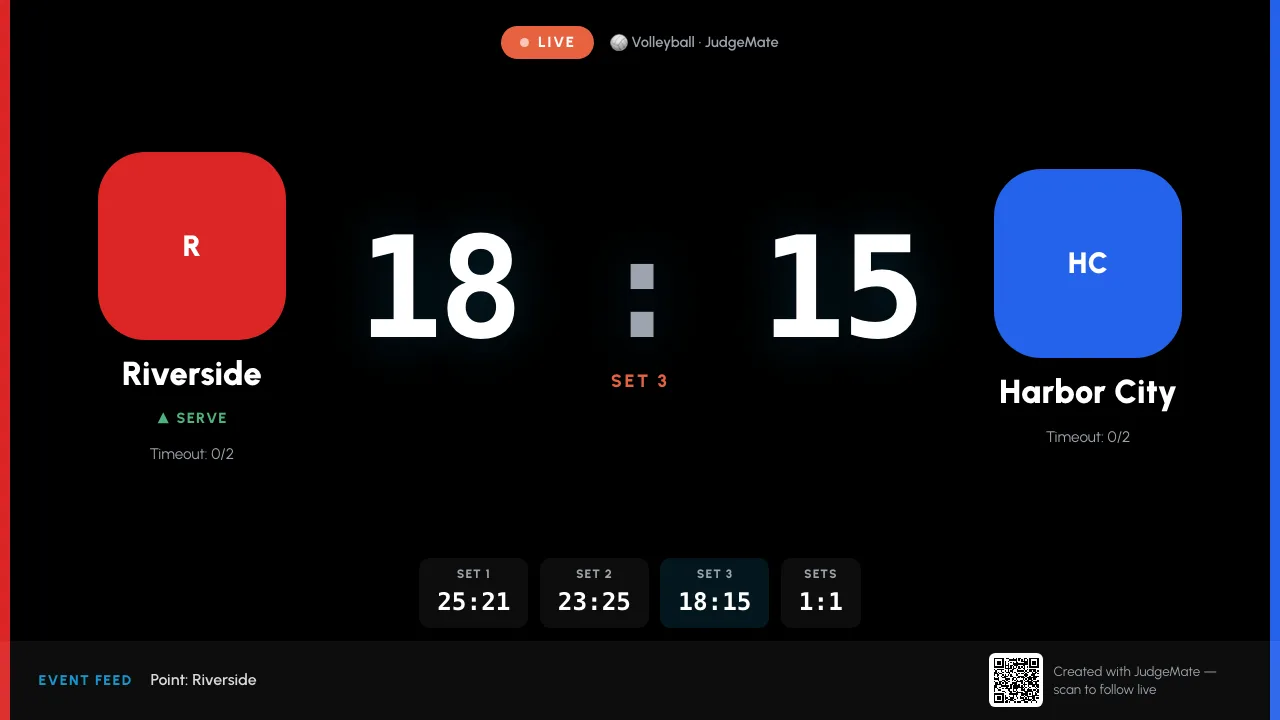
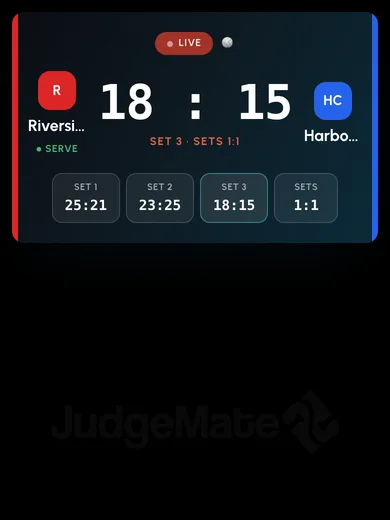
JudgeMate for basketball games
A full scoreboard, run from a phone
One phone controls the clock, scoreboard, shot clock, and fouls. A shared link shows the live view on any screen.
No sign-up
Open JudgeMate, pick basketball, enter team names, tip off. No account, no download, no trial. The admin works from a phone; fans open the spectator link on a TV, tablet, or their own phone.
Quarter timer
10:00 FIBA quarters by default, or 12:00 for NBA-style games. The clock pauses on dead balls and rolls the period over at zero. Overtime runs a 5-minute countdown. Admin phone and spectator screen stay in sync.
24 / 14 shot clock
A dedicated shot clock with one-tap start, 14-second reset after an offensive rebound or foul, and manual adjust. Visible on the admin panel and spectator view at the same time.
+1 / +2 / +3 scoring
Dedicated buttons for free throws, field goals, and threes. Tap to score, tap again to undo the last action. Built for fast input late in a close quarter.
Team fouls with bonus
Team fouls count per quarter. At the fifth team foul, the scoreboard flags bonus — from that foul on, the other team shoots free throws on every defensive foul. Counts reset per quarter; in overtime, the fourth-quarter count carries on automatically.
Kiosk display for the gym
The spectator link opens a full-screen scoreboard with team names, quarter, clock, score, and foul counts. Cast it to a TV or a projector. Updates land the moment the admin taps.
Match-day polls
Open quick polls during the match — MVP, best save, player of the match. Fans vote from their phones, the leaderboard moves in real time, and the archive shows what the crowd thought after every game.
1 more feature
Match-day polls
Open quick polls during the match — MVP, best save, player of the match. Fans vote from their phones, the leaderboard moves in real time, and the archive shows what the crowd thought after every game.
Basketball Competition Formats and Officiating
Competition Formats
5-on-5 Basketball (FIBA / NBA)Traditional 5-on-5 basketball is the standard format played worldwide at every level, from youth leagues to the Olympics and the NBA. FIBA rules govern international play: four 10-minute quarters, a 24-second shot clock (resetting to 14 seconds on offensive rebounds), and a 5-foul personal limit. The NBA uses 12-minute quarters, a similar shot clock system, and a 6-foul limit.
Traditional 5-on-5 basketball is the standard format played worldwide at every level, from youth leagues to the Olympics and the NBA. FIBA rules govern international play: four 10-minute quarters, a 24-second shot clock (resetting to 14 seconds on offensive rebounds), and a 5-foul personal limit. The NBA uses 12-minute quarters, a similar shot clock system, and a 6-foul limit.
Games are won by the team with the most points at the end of regulation. If the score is tied, overtime periods of 5 minutes (FIBA and NBA) are played until a winner is determined. Teams consist of 12 players on the roster with 5 on the court at any time. Substitutions are unlimited and can be made during any dead ball situation.
3x3 Basketball (Olympic since 2020)3x3 basketball became an official Olympic sport at the Tokyo 2020 Games. Played on a half-court with one basket, 3x3 features three players per team with one substitute. Games are played to 21 points or 10 minutes, whichever comes first. A shot clock of 12 seconds keeps the pace extremely fast.
3x3 basketball became an official Olympic sport at the Tokyo 2020 Games. Played on a half-court with one basket, 3x3 features three players per team with one substitute. Games are played to 21 points or 10 minutes, whichever comes first. A shot clock of 12 seconds keeps the pace extremely fast.
Scoring differs from 5-on-5: shots inside the arc are worth 1 point, shots beyond the arc are worth 2 points, and free throws are worth 1 point. The format emphasizes individual skill, quick decision-making, and physical toughness. 3x3 has grown rapidly with its own paid World Tour and dedicated ranking system governed by FIBA.
Streetball and Recreational BasketballStreetball is the informal, playground version of basketball that has its own rich culture and traditions. Played on outdoor courts worldwide, streetball typically uses modified rules — half-court play, make-it-take-it possession, and calling your own fouls. Iconic streetball venues like Rucker Park in New York City have produced legends and hosted games that draw thousands of spectators.
Streetball is the informal, playground version of basketball that has its own rich culture and traditions. Played on outdoor courts worldwide, streetball typically uses modified rules — half-court play, make-it-take-it possession, and calling your own fouls. Iconic streetball venues like Rucker Park in New York City have produced legends and hosted games that draw thousands of spectators.
Recreational and amateur basketball leagues represent the largest segment of basketball participation globally. From church leagues to corporate tournaments, these games need reliable scorekeeping just as much as top-level contests. JudgeMate's Free Scoreboard is built precisely for these situations — giving any game, at any level, a top-quality scoreboard experience without cost or complexity.
Officiating and Rule Enforcement
Basketball officiating requires a crew of 2 referees (FIBA standard for lower levels) or 3 referees (FIBA and NBA standard for top-level competition). Referees enforce the rules in real time, making split-second decisions on fouls, violations, and out-of-bounds calls. The lead official positions under the basket, while trail and slot officials cover the backcourt and weak side.
The complexity of basketball officiating has grown with the sport. Officials must manage personal fouls (5 per player in FIBA, 6 in NBA), team fouls (bonus free throws after the 4th team foul per quarter in FIBA), technical fouls for unsportsmanlike conduct, and flagrant/unsportsmanlike fouls for dangerous play. Instant replay review is used at the elite level for last-second shots, flagrant foul assessments, and out-of-bounds decisions in critical game moments.
- Fouls
- Personal fouls (5 FIBA / 6 NBA limit), offensive fouls, technical fouls, unsportsmanlike/flagrant fouls. Team foul bonus triggers free throws after the 4th foul per quarter (FIBA).
- Shot Clock
- 24 seconds for a new possession. Resets to 14 seconds on an offensive rebound (FIBA) or after a foul on the shooting team with 13 or fewer seconds remaining. Violation results in a turnover.
- Violations
- Traveling (moving without dribbling), double dribble, backcourt violation (8 seconds, both FIBA and NBA), 3-second lane violation, goaltending and basket interference, kick ball.
- Overtime
- 5-minute periods (both FIBA and NBA). Team fouls: FIBA counts overtime fouls toward the fourth quarter, while the NBA starts a new count in each overtime period. All personal fouls carry over. Game continues with additional overtime periods until a winner is determined.
Modern basketball officiating increasingly relies on technology. Instant replay systems, LED shot clocks integrated into the backboard, and electronic scoreboard systems are standard at the elite level. At the grassroots and amateur level, JudgeMate's Free Scoreboard brings essential game management technology — quarter timers, shot clock, foul tracking, and live scoring, to any court, from any phone.
Guides and tools about Basketball
- How Is Basketball Scored?Basketball scoring explained: 2- and 3-point field goals, free throws, shot clock, fouls and overtime, updated for the FIBA rules in force 1 October 2026.
- How to Referee BasketballBasketball officiating guide: lead/trail/center roles, court positioning, hand signals, foul criteria, and the FIBA certification path, with practice drills.
- How to Use a Live Basketball ScoreboardFree basketball scoreboard: +1/+2/+3 controls, countdown clock, shot clock, foul tracking, and spectator QR sharing. Run school or club games from your phone.
- What are the 5 positions in basketball?The positions in basketball are point guard, shooting guard, small forward, power forward and center. What each role does and what the FIBA rules say.
- What Are Basketball Violations and How Do They Differ From Fouls?Basketball violations explained: traveling, double dribble, hands-only, the 3/5/8/24-second rules, backcourt and goaltending under FIBA's OBR 2026 and OBRI.
- How Is the 2026 Women's Basketball World Cup Decided?How the 2026 FIBA Women's Basketball World Cup in Berlin is decided: the new 16-team format, the Qualification to Quarter-Finals round and FIBA's tiebreakers.
Show all (11)
- How does 3x3 basketball work and how is it scored?3x3 basketball rules and FIBA scoring: 1 point inside the arc, 2 beyond the 6.75 m line, first to 21 or 10 minutes, 12-second shot clock. 3x3 vs 5x5.
- What are the official basketball court dimensions?Basketball court dimensions compared: FIBA 28 m x 15 m vs NBA 28.65 m x 15.24 m, 3-point line 6.75 m vs 7.24 m, hoop height 3.05 m, free-throw and key sizes.
- What do basketball statistics actually mean?Basketball stats explained: how points, rebounds, assists, steals, blocks, field goal percentage and the box score work, plus double-double and triple-double.
- Run a season league
- Free tournament bracket generator
Frequently Asked Questions — Basketball & JudgeMate Free Scoreboard
Primary Sources
More about Basketball
6 sections · A full basketball scoreboard on your phone · The World's Biggest Basketball Competitions · Legendary Basketball Players · Basketball Equipment & Gear · Modern Trends in Basketball · The History of Basketball: From Peach Baskets to Global Phenomenon
More about Basketball
6 sections · A full basketball scoreboard on your phone · The World's Biggest Basketball Competitions · Legendary Basketball Players · Basketball Equipment & Gear · Modern Trends in Basketball · The History of Basketball: From Peach Baskets to Global Phenomenon
A full basketball scoreboard on your phone
Basketball is fast. Points land every few seconds, the shot clock ticks, team fouls pile up, quarters roll over. A good scoreboard keeps up with all of it.
JudgeMate runs that scoreboard from a phone. Quarter countdown (10:00 FIBA, 12:00 NBA-style), shot clock with 24/14 reset, foul counts with an automatic bonus indicator at 5, 5-minute overtime. Tap +1, +2, or +3 and the score updates everywhere.
Share a link and the gym TV, a projector, or spectators' phones all show the same live view. No sign-up, no app.
The World's Biggest Basketball Competitions
Basketball is played at the highest level across multiple prestigious competitions worldwide. From the NBA's nightly showcase to the Olympic Games' quadrennial drama, these events define the pinnacle of the sport.
NBA (National Basketball Association)
The NBA is the leading top-level basketball league in the world, featuring 30 teams across the United States and Canada. Founded in 1946, the NBA has produced the sport's greatest icons — from Michael Jordan and Kobe Bryant to LeBron James and Stephen Curry. The NBA season runs from October to June, culminating in the NBA Finals, which regularly attracts a global audience of hundreds of millions. The league's combination of elite talent, entertainment value, and global marketing has made it the world's most commercially successful basketball competition.
FIBA Basketball World Cup
The FIBA Basketball World Cup is the flagship international competition for men's national teams, held every four years. The tournament features 32 teams competing over a two-week period and serves as a primary qualifier for the Olympic Games. Historically dominated by the United States, the World Cup has seen increasing parity, with Spain, Argentina, Germany, and Serbia all winning or reaching finals in recent editions. The event showcases the global depth of basketball talent and generates massive viewership, particularly in basketball-passionate countries across Europe, the Americas, and Asia.
Olympic Basketball
Basketball has been an Olympic sport since the 1936 Berlin Games for men and the 1976 Montreal Games for women. Olympic basketball features 12 teams in each gender bracket, competing in a group stage followed by knockout rounds. The United States has historically dominated, winning the majority of gold medals, but the gap has narrowed significantly in recent decades. The 2004 Athens Olympics (Argentina gold) and 2023 FIBA World Cup (Germany gold) demonstrated that Olympic basketball is genuinely competitive. The 3x3 format was added at Tokyo 2020, expanding basketball's Olympic presence.
EuroLeague
The EuroLeague (officially Turkish Airlines EuroLeague) is Europe's top basketball club competition. Featuring 20 teams in the 2026-27 season, the EuroLeague runs from October to May and culminates in the Final Four — a weekend event widely considered the most intense club basketball in the world outside the NBA. Teams like Real Madrid, FC Barcelona, Olympiacos, Panathinaikos, and Fenerbahce compete for the title. The EuroLeague has served as a development pipeline for NBA talent and maintains an extremely high level of tactical and physical play.
Legendary Basketball Players
Basketball has produced some of the most iconic athletes in sports history. From the pioneers who shaped the game to today's superstars redefining what is possible on the court, these players represent the pinnacle of basketball excellence.
All-Time Legends
Michael Jordan
Widely regarded as the greatest basketball player of all time, Michael Jordan won 6 NBA championships with the Chicago Bulls and earned 5 MVP awards. His combination of scoring ability, defensive prowess, and clutch performances set the standard for competitive excellence. Jordan's cultural impact transcended basketball, turning the sport into a global phenomenon.
LeBron James
LeBron James is the NBA's all-time leading scorer and one of the few players to win championships with three different franchises (Miami Heat, Cleveland Cavaliers, Los Angeles Lakers). A 4-time NBA champion and 4-time MVP, LeBron's combination of size, speed, basketball IQ, and longevity is unprecedented. He has played at an elite level for over two decades, redefining the point-forward position.
Kareem Abdul-Jabbar
Kareem Abdul-Jabbar held the NBA all-time scoring record for 39 years (38,387 points) until LeBron James surpassed it in 2023. A 6-time NBA champion and 6-time MVP, Kareem dominated with his unstoppable skyhook — widely considered the most unblockable shot in basketball history. His career spanned 20 seasons with the Milwaukee Bucks and Los Angeles Lakers.
Magic Johnson
Magic Johnson reshaped the point guard position with his 6-foot-9 frame and rare passing vision. He won 5 NBA championships with the Los Angeles Lakers during the Showtime era and earned 3 MVP awards. Magic's rivalry with Larry Bird in the 1980s is credited with saving the NBA from declining popularity and ushering in the current era of top-level basketball.
Larry Bird
Larry Bird was one of the most complete players in NBA history — a deadly shooter, elite passer, and fierce competitor. He won 3 consecutive MVP awards (1984-1986) and 3 NBA championships with the Boston Celtics. Bird's basketball IQ and clutch shooting made him legendary, and his rivalry with Magic Johnson defined an entire era of the sport.
Kobe Bryant
Kobe Bryant spent his entire 20-year career with the Los Angeles Lakers, winning 5 NBA championships and earning 2 Finals MVP awards. Known for his relentless work ethic and "Mamba Mentality," Kobe scored 81 points in a single game — the second-highest total in NBA history. His technical skill and competitive drive made him one of the most revered players worldwide.
Bill Russell
Bill Russell is the most decorated winner in NBA history, capturing 11 championships in 13 seasons with the Boston Celtics. A genre-defining defensive player, Russell transformed basketball into a team-first sport with his shot-blocking and rebounding dominance. He was also a pioneering figure as the NBA's first Black head coach, breaking racial barriers in American paid-league sports.
Tim Duncan
Tim Duncan, known as "The Big Fundamental," won 5 NBA championships with the San Antonio Spurs across three different decades. A 2-time MVP and 3-time Finals MVP, Duncan's consistency, fundamentally sound game, and quiet leadership defined the Spurs dynasty. He is widely considered the greatest power forward in basketball history.
Current Stars
Nikola Jokic
Nikola Jokic has redefined the center position with his court-wide passing and playmaking ability. The Serbian star has won 3 NBA MVP awards and led the Denver Nuggets to their first championship in 2023, earning Finals MVP. Jokic's unique skill set — combining elite scoring, rebounding, and point-guard-level assists — makes him one of the most versatile big men ever.
Giannis Antetokounmpo
Giannis Antetokounmpo, the "Greek Freak," is a 2-time MVP who led the Milwaukee Bucks to the 2021 NBA championship with a legendary Finals performance. Born in Athens to Nigerian immigrant parents, Giannis's combination of 7-foot height, guard-like speed, and relentless drive to the basket makes him almost impossible to stop. He is one of the most dominant physical specimens in basketball history.
Luka Doncic
Luka Doncic burst onto the NBA scene as a teenage EuroLeague MVP and has become one of the league's top scorers and playmakers. The Slovenian superstar regularly posts triple-double performances and led the Dallas Mavericks to the 2024 NBA Finals. Doncic's step-back three-pointer and creative passing have drawn comparisons to the greatest guards in history.
Jayson Tatum
Jayson Tatum led the Boston Celtics to the 2024 NBA championship, establishing himself as one of the league's elite two-way wings. A multi-time All-Star and Olympic gold medalist, Tatum combines smooth scoring from all three levels with increasingly impactful defense. Born in 1998, he has already cemented his place among the best players of his generation.
Shai Gilgeous-Alexander
Shai Gilgeous-Alexander has emerged as one of the NBA's most unstoppable scorers, leading the Oklahoma City Thunder's rapid rebuild. The Canadian guard's unique combination of length, mid-range mastery, and craftiness around the rim makes him nearly unguardable. SGA won the 2024-25 scoring title and back-to-back MVP awards (2025, 2026), and led the Thunder to the 2025 NBA title.
Victor Wembanyama
Victor Wembanyama is the most hyped prospect since LeBron James, and the French phenom has lived up to the billing. Standing 7-foot-4 with a 8-foot wingspan, Wembanyama combines elite shot-blocking with guard-like ball-handling and three-point shooting. Named 2024 Rookie of the Year with the San Antonio Spurs, he is already being projected as a generational talent who could redefine basketball.
Anthony Edwards
Anthony Edwards has evolved into one of the NBA's most explosive and entertaining players, leading the Minnesota Timberwolves to the Western Conference Finals in 2024. Known for his thunderous dunks, clutch three-point shooting, and fearless competitiveness, Edwards brings a charisma and swagger reminiscent of young Michael Jordan. He is widely seen as a future face of the NBA.
A'ja Wilson
A'ja Wilson is the dominant force in women's basketball, winning 4 WNBA MVP awards (2020, 2022, 2024, 2025) and the 2022, 2023, and 2025 WNBA championships with the Las Vegas Aces. Wilson's combination of post scoring, mid-range shooting, and defensive versatility makes her the most complete player in the WNBA. She also starred for Team USA at the Olympics, solidifying her status as the face of women's basketball.
Breanna Stewart
Breanna Stewart is a 2-time WNBA MVP and 3-time WNBA champion: 2018 and 2020 with the Seattle Storm, 2024 with the New York Liberty. At 6-foot-4, Stewart's ability to score from anywhere on the court, combined with elite rebounding and shot-blocking, makes her one of the most versatile players in WNBA history. She has also been a vocal advocate for women's sports equality.
Sabrina Ionescu
Sabrina Ionescu set the NCAA record for career triple-doubles at the University of Oregon and has become one of the WNBA's brightest stars with the New York Liberty. Her deep three-point range, court vision, and competitive fire have made her a fan favorite and marketing powerhouse. Ionescu's three-point contest against Stephen Curry during NBA All-Star Weekend became a landmark moment for women's basketball visibility.
Basketball Equipment & Gear
Basketball is one of the most accessible sports in the world, requiring minimal equipment to play. However, at the competitive level, the quality and specifications of gear are tightly regulated by FIBA and the NBA to ensure fair play and player safety.
Basketball
The official basketball is a size 7 (29.5 inches circumference, ~22 oz) for men's competition and size 6 (28.5 inches) for women's. FIBA-approved balls use composite leather or genuine leather and must meet strict bounce, weight, and grip standards. Spalding standardized the iconic orange color with black seams in the 1970s. Indoor and outdoor balls differ in material — leather for indoor courts, rubber or synthetic composites for outdoor play.
Basketball Shoes
Basketball shoes are among the most engineered athletic footwear, designed to provide ankle support, cushioning, and traction on hardwood courts. Today's designs range from high-tops for maximum ankle stability to low-cuts favored by guards for agility. The basketball shoe industry, driven by signature lines from stars like Jordan, LeBron, and Curry, generates over $6 billion annually and has become a major cultural force beyond the sport itself.
Backboard & Hoop
The regulation backboard is a 6-by-3.5-foot rectangular tempered glass surface, with the rim mounted on it 10 feet above the floor. The hoop (rim) has an 18-inch inner diameter and features a breakaway mechanism that flexes under force to prevent injury and equipment damage during dunks. Top-level arenas use LED-lit shot clocks integrated into the backboard structure. The net — typically white nylon — slows the ball after made baskets for clear visibility.
Jersey & Shorts
Basketball uniforms have evolved from tight-fitting shorts and tank tops to the loose, below-the-knee shorts popularized by Michael Jordan in the 1990s. Today's jerseys use lightweight, moisture-wicking synthetic fabrics for comfort during intense play. FIBA and NBA rules require specific numbering, team colors, and sponsor placement. The basketball jersey has become one of the most iconic pieces of sports apparel, with player jerseys among the best-selling merchandise in paid-league sports.
Shot Clock & Game Clock
The 24-second shot clock is a mandatory piece of equipment in all official basketball competitions, typically mounted above the backboard. The game clock, managed by the scorer's table, tracks quarter and overtime periods. Top-level arenas use synchronized LED systems visible from every seat. At the grassroots level, JudgeMate's Free Scoreboard replaces expensive hardware with a phone-based digital solution, providing shot clock, game clock, and foul tracking — all synchronized in real time.
Modern Trends in Basketball
Basketball is evolving faster than ever, driven by analytics, global expansion, and shifting cultural dynamics. These trends are reshaping how the game is played and coached at every level.
Analytics Revolution
Deep-data analytics have fundamentally transformed basketball strategy. Player tracking technology captures every movement on the court, speed, distance, positioning, and shot selection, generating terabytes of data per game. Teams employ dedicated analytics departments that identify optimal shot locations, defensive matchups, and lineup combinations. The result is a game increasingly driven by data: the near-extinction of the mid-range jumper, the rise of the corner three, and structured load management protocols. Analytics has democratized basketball knowledge, allowing coaches at every level to make more informed decisions.
Load Management & Sports Science
Today's sports science has reshaped how basketball players train, recover, and extend their careers. Load management, strategically resting players during the regular season, has become standard practice, prioritizing long-term health over short-term results. Players now use cryotherapy, sleep optimization, nutrition science, and biometric monitoring to maintain peak performance. The result is that elite players routinely compete at the highest level into their late 30s, a feat that was rare just two decades ago. LeBron James playing at an MVP level past age 38 exemplifies this trend.
Positionless Basketball
The traditional five positions (point guard, shooting guard, small forward, power forward, center) are increasingly blurred in today's basketball. Positionless basketball features versatile players who can shoot, pass, dribble, and defend across multiple positions. Centers like Nikola Jokic run the offense as primary playmakers, while guards like Shai Gilgeous-Alexander dominate in the post. This evolution rewards skill, basketball IQ, and versatility over rigid positional roles, producing the most aesthetically diverse basketball in history.
The Three-Point Era
The three-point revolution, catalyzed by Stephen Curry and the Golden State Warriors dynasty, has fundamentally changed basketball at every level. NBA teams now average over 35 three-point attempts per game, compared to just 16 in 2000. The math is undeniable: a 35% three-point shooter generates 1.05 points per attempt, more efficient than a 52% two-point shooter. This has reshaped youth development, where young players now prioritize perimeter shooting from an early age. FIBA has responded by moving the three-point line back to 6.75 meters, and debates continue about further changes to balance the game.
Women's Basketball Growth
Women's basketball is experiencing unprecedented growth in popularity and investment. The WNBA has seen record viewership and attendance, driven by transcendent stars like A'ja Wilson, Breanna Stewart, and Caitlin Clark. College women's basketball shattered attendance records, with the 2024 NCAA Championship game drawing 18.9 million viewers. New top-level leagues, increased media coverage, and corporate sponsorships are transforming the women's game. The generational influx of talent and fan engagement suggests that women's basketball is entering a golden era of visibility and commercial viability.
FIBA Global Expansion
Basketball's international footprint continues to expand, with FIBA investing heavily in grassroots development across Africa, Asia, and the Americas. The Basketball Africa League (BAL), launched in partnership with the NBA, represents the sport's frontier of growth. International players now constitute over 25% of NBA rosters, with stars like Jokic, Giannis, Doncic, and Wembanyama dominating the league. FIBA's 3x3 format has brought basketball to new audiences through its Olympic inclusion and urban tournament circuits. At the grassroots level, tools like JudgeMate's Free Scoreboard make it possible for any community, anywhere in the world, to run organized basketball games with top-quality score tracking, quarter timers, and shot clocks, all from a simple phone browser.
The History of Basketball: From Peach Baskets to Global Phenomenon
James Naismith's Invention (1891)
Basketball was invented in December 1891 by Dr. James Naismith, a Canadian-American physical education instructor at the International YMCA Training School in Springfield, Massachusetts. Tasked with creating an indoor game to keep students active during the harsh New England winter, Naismith wrote 13 original rules and nailed a peach basket to an elevated track at each end of the gymnasium. The first game was played with nine players on each side and a soccer ball.
Naismith's original rules established many principles that still define basketball today: the ball could be thrown in any direction, players could not run with the ball, and no shouldering or holding was allowed. The game spread rapidly through the YMCA network across the United States and internationally. By 1936, basketball had become an official Olympic sport at the Berlin Games, fulfilling Naismith's dream of global recognition. He attended the Berlin Olympics and personally presented the medals.
The Birth of the NBA (1946-1949)
Top-level basketball in the United States took shape with the founding of the Basketball Association of America (BAA) in 1946 and its merger with the National Basketball League (NBL) in 1949 to form the National Basketball Association (NBA). The early NBA struggled for attendance and media attention, but the arrival of transformative players changed everything.
George Mikan dominated the late 1940s and 1950s, forcing rule changes (including the widening of the lane) to balance the game. The 1950s and 1960s saw the legendary rivalry between Bill Russell's Boston Celtics and Wilt Chamberlain's teams, establishing basketball as a major American paid-league sport. The introduction of the 24-second shot clock in 1954, invented by Danny Biasone, changed the game by eliminating stalling tactics and creating the fast-paced, high-scoring sport we know today.
FIBA and Global Expansion
The International Basketball Federation (FIBA) was founded in 1932, initially with eight member nations. Today, FIBA has 213 national member federations, making basketball one of the most widely governed sports in the world. FIBA established standardized rules that differ in several ways from NBA rules. 10-minute quarters instead of 12, a trapezoidal (now rectangular) lane, and different foul limit thresholds.
The 1992 Barcelona Olympics marked a watershed moment when the United States sent the "Dream Team", featuring Michael Jordan, Magic Johnson, and Larry Bird, to Olympic competition for the first time. This event catalyzed basketball's global popularity and inspired generations of international players. Countries like Spain, Argentina, Serbia, Lithuania, Australia, and France developed top basketball programs, and the flow of international talent into the NBA transformed the league into a truly global institution.
The Modern Era: Three-Point Revolution and Analytics
The three-point line, introduced by the NBA in 1979 and adopted by FIBA in 1984, fundamentally transformed basketball strategy. Initially underutilized, the three-pointer became a central weapon in the 2010s, led by Stephen Curry and the Golden State Warriors dynasty. Teams shifted from post-up, mid-range basketball to spacing-heavy, perimeter-oriented offenses that maximized three-point attempts.
Analytics accelerated this transformation. Data-driven insights revealed that the most efficient shots were at the rim and behind the three-point arc, leading to the near-extinction of the mid-range jumper at the top level. Player tracking technology, introduced in 2013, provided granular data on speed, distance, and positioning. Today's basketball is a blend of elite athleticism, strategic complexity, and data-driven decision-making. And managing a top-level game needs digital tools that keep pace with this evolution.
Start a Free Basketball Scoreboard
Give your next game a scoreboard that keeps up. JudgeMate runs the clock, shot clock, score, and fouls from one phone — free.
Used by school coaches, referees, and community organizers. Tip off in under a minute.