
Volleyball scoreboard, free, built for rallies
Club matches, school tournaments, league nights
Volleyball uses rally point scoring where every rally awards a point. The first referee (on a platform) holds final authority, supported by a second referee, line judges, and optional video challenge system. Sets end at 25 points (15 in tiebreak) with a 2-point advantage. Matches are best-of-5 sets.
JudgeMate for Volleyball
Everything runs in the browser — phone, tablet or laptop, nothing to install.
Start a volleyball scoreboard
Free, no account. Share the spectator link and show the board on a big screen.
Guides for this sport
11 guides on rules, scoring and running a competition
JudgeMate for volleyball matches
Set-based scoring, no clock, no setup
JudgeMate knows the volleyball rules. No timer to configure — just sets, the 2-point rule, and a match that ends on its own at three sets won.
No sign-up
Pick volleyball, type the team names, start scoring. No account, no payment. The scoreboard gets a shareable link anyone can open to follow along.
Auto set-end at 25 / 15
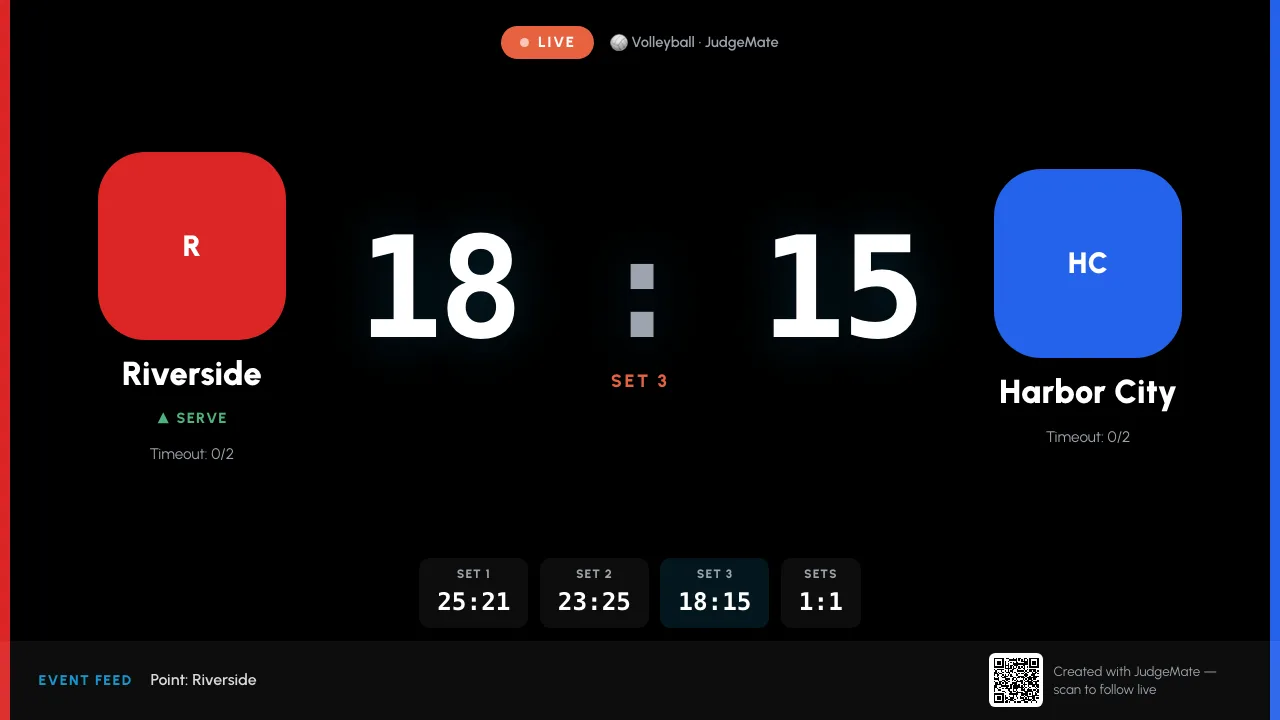
Sets 1–4 end at 25 points, set 5 at 15, both with a 2-point advantage. At 24-24 the set runs on until one team leads by two. The server closes the set the instant it's decided.
Serve indicator
Tap to toggle the serve. The indicator shows on the admin panel and the spectator view. Serve switches automatically at set break; manual override handles rotation fixes.
No clock
Volleyball runs on rallies, not minutes. The interface shows what matters — the current set, match score, and serve, and nothing else.
Set history
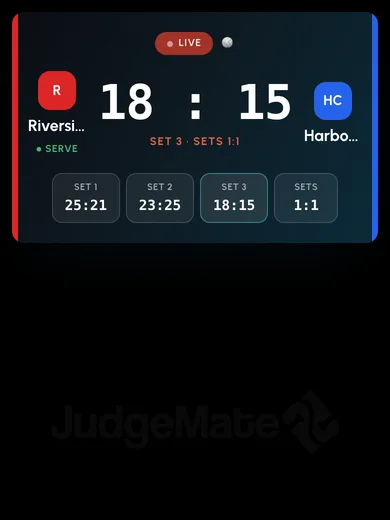
Finished sets stay on screen next to the current one. A spectator joining in set 3 sees set 1 (25-21) and set 2 (23-25) at a glance.
Match ends at 3 sets
Best-of-5 is built in. The match closes the moment a team wins three sets — 3-0 or 3-2, and the final state preserves every set score.
Match-day polls
Open quick polls during the match — MVP, best save, player of the match. Fans vote from their phones, the leaderboard moves in real time, and the archive shows what the crowd thought after every game.
1 more feature
Match-day polls
Open quick polls during the match — MVP, best save, player of the match. Fans vote from their phones, the leaderboard moves in real time, and the archive shows what the crowd thought after every game.
How Volleyball Competitions Work
Volleyball Formats
Indoor Volleyball (6v6)Indoor volleyball is the sport's flagship format, played on a 18m x 9m court with teams of six players separated by a net (2.43m for men, 2.24m for women). Each team is allowed a maximum of three contacts per possession before returning the ball over the net. Matches are played as best-of-5 sets, with the first four sets played to 25 points and the deciding fifth set (tiebreak) played to 15 points, all requiring a minimum 2-point advantage.
Indoor volleyball is the sport's flagship format, played on a 18m x 9m court with teams of six players separated by a net (2.43m for men, 2.24m for women). Each team is allowed a maximum of three contacts per possession before returning the ball over the net. Matches are played as best-of-5 sets, with the first four sets played to 25 points and the deciding fifth set (tiebreak) played to 15 points, all requiring a minimum 2-point advantage.
Teams employ specialized positions: setters orchestrate the offense, outside hitters (opposite and wing spikers) attack from various positions, middle blockers dominate the net, and the libero — a defensive specialist wearing a contrasting jersey, handles passing and digging in the back row. Player rotation cycles all six positions through serving, and substitution rules allow teams to make strategic adjustments throughout each set.
Beach Volleyball (2v2)Beach volleyball pits two-player teams against each other on a smaller sand court (16m x 8m). The reduced team size eliminates specialized positions: both players must handle serving, passing, setting, attacking, plus blocking. Matches use a best-of-3 format with sets played to 21 points (15 in the tiebreak), all requiring a 2-point advantage.
Beach volleyball pits two-player teams against each other on a smaller sand court (16m x 8m). The reduced team size eliminates specialized positions: both players must handle serving, passing, setting, attacking, plus blocking. Matches use a best-of-3 format with sets played to 21 points (15 in the tiebreak), all requiring a 2-point advantage.
Beach volleyball became an Olympic sport at the 1996 Atlanta Games and has since grown into a global phenomenon with its own dedicated top-level tour (since 2022, the Volleyball World Beach Pro Tour). The format's accessibility (requiring only a net, a ball, and sand) has made it one of the world's most popular recreational sports, while the top-level circuit runs intense, fast-paced competition that consistently draws large audiences at major events.
Sitting Volleyball (Paralympic)Sitting volleyball is an adaptive version of the sport designed for athletes with physical disabilities, played on a smaller court (10m x 6m) with a lower net (1.15m for men, 1.05m for women). Players must maintain contact with the floor with their pelvis at all times during play, creating a dynamic game that emphasizes quick reflexes, upper-body strength, and tactical positioning.
Sitting volleyball is an adaptive version of the sport designed for athletes with physical disabilities, played on a smaller court (10m x 6m) with a lower net (1.15m for men, 1.05m for women). Players must maintain contact with the floor with their pelvis at all times during play, creating a dynamic game that emphasizes quick reflexes, upper-body strength, and tactical positioning.
Sitting volleyball has been part of the Paralympic Games since 1980 (men) and 2004 (women), with Iran, Bosnia and Herzegovina, and the United States among the historically dominant nations. The sport follows the same basic rules as indoor volleyball — rally scoring, best-of-5 sets, rotation, with adaptations for the seated playing position. Growing participation and media coverage are helping sitting volleyball reach wider audiences and inspire athletes worldwide.
How Volleyball Officiating Works
Volleyball officiating relies on a crew of referees and officials working together to ensure fair, accurate calls. The first referee (R1) stands on an elevated platform at one end of the net and holds final authority over all decisions. The second referee (R2) stands on the opposite side at floor level, focusing on net violations, center-line faults, and managing substitutions. Line judges (typically two or four) monitor boundary lines and signal whether balls land in or out of the court.
Unlike judged sports where scores reflect subjective evaluation, volleyball officials enforce objective rules: the ball is either in or out, the rotation is either correct or not, the block either touched the net or didn't. This binary nature of volleyball officiating makes the sport particularly well-suited to technology-assisted officiating and real-time electronic scoring.
- Rally Scoring
- Every rally results in a point for one team, regardless of which team served. Sets are played to 25 points (15 in tiebreak), with a mandatory 2-point advantage required to win any set.
- Rotation & Positional Faults
- Teams must rotate clockwise each time they win the serve back. Players of the receiving team must be in their correct rotational positions at the moment of service. Positional faults result in a point and service for the opposing team.
- Libero Rules
- The libero is a back-row defensive specialist who wears a different colored jersey. The libero cannot serve (except in some domestic leagues) or attack the ball above net height from anywhere on the court, and if the libero sets the ball overhand from in front of the attack line, the attack that follows cannot be completed above net height.
- Challenge System
- Teams receive a limited number of video challenges per set (typically two) to dispute referee calls on ball in/out, touch calls, and net violations. Successful challenges are retained; failed challenges are lost.
Modern volleyball officiating increasingly relies on technology for accuracy. The Hawk-Eye ball-tracking system produces instant in/out decisions, electronic substitution boards manage player changes, and real-time statistics systems track every contact. JudgeMate's Free Scoreboard complements these tools by providing accessible, real-time set tracking and score display that anyone can use — from professional arenas to community gym leagues.
Guides and tools about Volleyball
- How Is Volleyball Scored?How many points you play to in volleyball: sets to 25, the fifth set to 15, win by 2. Rally scoring explained, plus 2026 FIVB tests and NCAA and NFHS changes.
- How to Referee VolleyballHow volleyball is officiated under the Official Volleyball Rules 2025-2028: the refereeing team, hand signals, net and center-line faults, the Challenge referee, and the 2026 NCAA changes.
- How to Use a Live Volleyball ScoreboardFree volleyball scoreboard. Track points and sets (best of 5), serve indicator, and share live scores via QR code. Run club matches or tournaments, no sign-up.
- What are the six volleyball positions and what does each player do?Volleyball positions explained: what the setter, outside hitter, opposite, middle blocker, libero, and defensive specialist each do on court in a 5-1 lineup.
- How do volleyball rotation systems work — 5-1, 6-2 and 4-2?What volleyball rotations are, how players rotate, and how the 5-1, 6-2 and 4-2 systems work, with attackers per rotation and a worked example.
- What Are the Ball-Handling and Hits Rules in Volleyball?Volleyball hits rules explained: the three-hit limit, double contacts, lifts and carries, four-hit faults, and why a block touch doesn't count. FIVB 2025-2028.
Show all (13)
- What are the official volleyball court dimensions and net height?A volleyball court is 18 m long and 9 m wide, with the net at 2.43 m (men) and 2.24 m (women). See every line, zone and measurement to FIVB standard.
- What are the volleyball substitution rules?Volleyball substitution rules explained: FIVB allows six subs per set, the libero swaps freely and does not count, and US college and school limits differ.
- How Is Beach Volleyball Scored?How beach volleyball scoring works: rally scoring, sets to 21 (tiebreak to 15), best of 3, side switching, and differences from indoor, with worked examples.
- How to Referee Beach VolleyballBeach volleyball officiating: referee roles, hand signals, open-hand tips, double contact, side switching, and the FIVB challenge system, with worked cases.
- How to Use a Live Beach Volleyball ScoreboardFree beach volleyball scoreboard: sets to 21, tiebreak to 15, serve indicator, auto set-end, and live QR sharing. Run any match from your phone, no sign-up.
- Run a season league
- Free tournament bracket generator
Frequently Asked Questions About Volleyball & JudgeMate Scoreboard
Primary Sources
- FIVB Volleyball Rules of the Game 2025–2028 — FIVB
- USA Volleyball Indoor Rulebook — USA Volleyball
More about Volleyball
6 sections · Volleyball has no clock. The scoreboard shouldn't either. · The World's Biggest Volleyball Competitions · Legendary Volleyball Players · Key Volleyball Equipment · Current Trends in Volleyball · The History and Evolution of Volleyball
More about Volleyball
6 sections · Volleyball has no clock. The scoreboard shouldn't either. · The World's Biggest Volleyball Competitions · Legendary Volleyball Players · Key Volleyball Equipment · Current Trends in Volleyball · The History and Evolution of Volleyball
Volleyball has no clock. The scoreboard shouldn't either.
Volleyball is the one major team sport with no game clock. A set ends when a team reaches the target points with at least a 2-point advantage. A set can last ten minutes or forty. Generic scoreboard apps built around timers don't fit.
JudgeMate is built for the set format. The server ends a set at 25 (15 in set 5) with the 2-point rule, keeps the set history, and closes the match the moment one team wins three sets.
Admin taps +1 for either team, toggles the serve, and the system does the rest. The spectator view shows the current set, overall set count, and completed set scores — project it on a gym screen, share a link, drop it into a stream overlay. Runs in the browser. No sign-up.
The World's Biggest Volleyball Competitions
Top-level volleyball features a rich calendar of elite competitions spanning Olympic Games, world championships, and continental club tournaments. These events showcase the world's best players and teams competing at the highest level of the sport.
FIVB Volleyball World Championship
The FIVB World Championship is the most prestigious volleyball tournament outside the Olympics, first held in 1949 (men) and 1952 (women) and, since 2025, played every two years. Thirty-two national teams compete across multiple rounds over approximately three weeks, making it the largest volleyball event by number of teams and matches. Historical powerhouses include Brazil, Russia, Italy, and Poland in men's competition, and Cuba, China, Russia, and the United States in women's play. The World Championship serves as a key Olympic qualifying event and a proving ground for the sport's emerging nations.
Olympic Volleyball
Volleyball has been an Olympic sport since Tokyo 1964, with both indoor (6v6) and beach (2v2, since Atlanta 1996) formats represented. The Olympic volleyball tournament features 12 national teams competing over two weeks in a format that combines group play with knockout rounds. Olympic volleyball consistently draws massive global television audiences, with the gold medal match among the most-watched events of any Summer Games. Dominant nations include Brazil, the United States, the Soviet Union/Russia, and Japan, while legendary duos from Brazil, the United States, and Germany have headlined beach volleyball.
FIVB Volleyball Nations League (VNL)
The Volleyball Nations League, launched in 2018 as the successor to the World League (men) and Grand Prix (women), is the leading annual international volleyball competition. Since 2025, eighteen national teams compete in a round-robin preliminary phase held across multiple host cities worldwide, followed by a final-round tournament featuring the top eight teams. The VNL combines high-level competition with a global travel format that brings elite volleyball to diverse markets, helping grow the sport's international footprint and fan base.
CEV Champions League
The CEV Champions League is European club volleyball's most prestigious tournament, bringing together the continent's top top-level teams. Modeled on football's UEFA Champions League format, the competition features group stages followed by knockout rounds culminating in a Super Finals weekend. Historic clubs like Trentino, Zenit Kazan, VakifBank Istanbul, and Conegliano have dominated the competition, showcasing the world's best top-level players competing for their clubs rather than national teams. The Champions League represents the pinnacle of the top-level volleyball club circuit.
Legendary Volleyball Players
Volleyball has produced some of the most iconic athletes in team sports history. From pioneers who defined today's game to the superstars pushing the boundaries of what is possible on the court, these players have shaped volleyball into the global spectacle it is today.
All-Time Legends
Karch Kiraly
Karch Kiraly is widely regarded as the greatest volleyball player of all time. He won two Olympic gold medals in indoor volleyball (1984, 1988) and one in beach volleyball (1996), making him the only player to achieve gold in both disciplines. As a coach, he led the U.S. Women's national team to Olympic gold in 2020.
Lang Ping
Known as the "Iron Hammer," Lang Ping dominated international volleyball in the 1980s as China's star spiker, leading her team to the 1984 Olympic gold medal. She later became an equally legendary coach, guiding China to the 2016 Olympic title, making her one of the few individuals to win Olympic gold as both player and coach.
Giba
Gilberto Amauri de Godoy Filho, known as Giba, was the face of Brazil's volleyball golden era. He won three World Championships (2002, 2006, 2010) and an Olympic gold medal in 2004, earning recognition as the FIVB Best Player multiple times. His explosive athleticism and leadership defined a generation of Brazilian volleyball.
Lorenzo Bernardi
Lorenzo Bernardi is considered the greatest Italian volleyball player in history and one of the best opposites ever. He won the 1990 World Championship with Italy, earned multiple European Championships, and dominated club volleyball with legendary teams. The FIVB named him the Best Player of the 20th Century.
Hugo Conte
Hugo Conte was Argentina's volleyball icon and one of the most talented outside hitters of the 1980s. He led Argentina to a historic bronze medal at the 1988 Seoul Olympics, the nation's finest volleyball achievement. His technical brilliance and court vision set new standards for the outside hitter position.
Renan Dal Zotto
Renan Dal Zotto was a key figure in Brazil's rise to volleyball prominence during the 1980s and 1990s. He helped Brazil win the silver medal at the 1984 Olympics and later became a successful coach, guiding the national team as head coach. His contributions span decades of Brazilian volleyball excellence.
Regla Torres
Regla Torres is one of the few volleyball players in history to win three consecutive Olympic gold medals (1992, 1996, 2000), all with Cuba's dominant women's team. Standing at 1.91m, she was a genre-defining middle blocker whose combination of height, speed, and timing redefined the position. The FIVB named her the Best Female Player of the 20th Century.
Sergey Tetyukhin
Sergey Tetyukhin holds the remarkable distinction of competing in six consecutive Olympic Games (1996–2016) for Russia, winning an Olympic gold in 2012 at age 36. He earned a 2002 World League title and a 2002 World Championship silver and served as Russia's flag bearer at the 2016 Rio Olympics. His longevity and consistency stand alone in volleyball history.
Current Stars
Wilfredo León
Wilfredo León is widely considered one of the hardest-hitting attackers in today's volleyball. Born in Cuba, he became a Polish citizen in 2015 and since 2019 has led Poland's national team with his rare hitting power. His spike reach and raw athleticism make him nearly impossible to defend when at his best.
Earvin N'Gapeth
Earvin N'Gapeth is the creative genius of French volleyball and one of the sport's most entertaining players. He led France to their historic first Olympic gold medal in 2021 and is known for his unorthodox playing style, including behind-the-back passes and acrobatic digs that delight fans worldwide.
Yuji Nishida
Yuji Nishida is Japan's volleyball prodigy and one of the most explosive opposites in the world. Despite Japan's traditionally smaller stature in men's volleyball, Nishida's heavy serve and rare vertical leap have made him a global star. As of 2026, he plays for Osaka Bluteon in Japan's SV.League, competing against the world's best on a weekly basis.
Matt Anderson
Matt Anderson is one of the most versatile players in American volleyball history. Standing at 2.02m, he combines height with exceptional all-around skills as an outside hitter, excelling in both attack and serve reception. He has been a cornerstone of the U.S. National team and has had a distinguished career in top European leagues.
Paola Egonu
Paola Egonu is considered one of the most dominant female players in today's volleyball. The Italian opposite hitter possesses one of the hardest spikes in the women's game, regularly exceeding 100 km/h. She has led her club teams to Champions League titles and is the face of Italian women's volleyball on the global stage.
Tijana Bošković
Tijana Bošković is a Serbian opposite hitter widely recognized as one of the best players on the planet. She was named MVP of the 2018 World Championship at just 21 years old, leading Serbia to the title. Her combination of power, accuracy, and composure under pressure makes her a threat in every match she plays.
Zhu Ting
Zhu Ting is China's volleyball superstar and one of the most decorated outside hitters in the current era. She was the MVP of the 2016 Olympic Games and has won multiple club titles with VakifBank Istanbul. Her intelligent attack placement, combined with physical power, makes her one of the most complete players in volleyball history.
Alessia Orro
Alessia Orro is one of Italy's finest setters and a key architect of the Italian women's volleyball resurgence. Her precise setting, court awareness, and ability to run fast-paced offensive systems have made her indispensable to both her club and national team. She represents the current evolution of the setter position.
Bartosz Kurek
Bartosz Kurek is a Polish volleyball icon and one of the most explosive opposites of his generation. He was named MVP of the 2018 World Championship as Poland retained the title in Turin. Known for his thunderous spike and clutch performances in decisive moments, Kurek is one of the most celebrated players in Polish volleyball history.
Yoandy Leal
Yoandy Leal is a Cuban-born Brazilian outside hitter known for his rare left-handed attack. He became a Brazilian citizen and has been a vital part of Brazil's national team, bringing explosive power and versatility. His ability to score from any position on the court makes him one of the most dangerous attackers in world volleyball.
Key Volleyball Equipment
Volleyball requires relatively minimal equipment compared to many other team sports, making it one of the most accessible sports worldwide. However, at the competitive level, each piece of equipment is carefully designed and regulated to ensure fair play and player safety.
Volleyball
The official volleyball is a spherical leather or synthetic leather ball with a circumference of 65–67 cm and weight of 260–280 grams. Indoor volleyballs are typically white or tri-colored, while beach volleyballs are slightly larger, lighter, and have a rougher texture for better grip in outdoor conditions. Mikasa is the official ball supplier for FIVB competitions, with the V200W model used at the Olympics and World Championships.
Net & Posts
The volleyball net spans the full 9m width of the court (the net itself is 9.50–10m long) and is 1m tall, set at a height of 2.43m for men and 2.24m for women. It is held taut by steel cables and attached to adjustable metal posts positioned 0.50–1.00m outside the sidelines. The net must maintain consistent tension and height across its entire span, and the top band features a white canvas strip for clear visibility.
Volleyball Shoes
Volleyball shoes are specifically engineered for the sport's unique movement demands: explosive jumping, lateral shuffling, and quick directional changes. They feature gum rubber outsoles for maximum court grip, specialized cushioning systems in the forefoot and heel for impact absorption during landings, and lightweight construction to minimize fatigue. Leading brands like Mizuno, ASICS, and Nike dominate the top-level market.
Knee Pads
Knee pads are key protective equipment in volleyball, particularly for defensive specialists and liberos who frequently dive to the floor. Today's volleyball knee pads use high-density foam or gel padding with breathable, moisture-wicking sleeves that stay in place during intense play. They protect against impact injuries and floor burns while allowing full range of motion for digging and rolling.
Antenna
The antennas are flexible fiberglass rods (1.80m tall, 10mm diameter) attached to each side of the net, directly above the sideline markings. They extend 80cm above the net and serve as visual boundary markers — the ball must cross the net between the two antennas for a legal play. Any ball touching an antenna or crossing outside it is ruled out. Antennas are painted in alternating red and white bands for high visibility.
Current Trends in Volleyball
Volleyball is evolving rapidly, driven by advances in technology, changes in player development pathways, and the sport's growing global commercial appeal. From data-driven coaching to digital fan engagement, these are the trends shaping volleyball's future.
Analytics & Video Analysis
Top-level volleyball teams now rely heavily on data analytics and video analysis platforms like Data Volley and Volleymetrics to break down every aspect of the game. Coaches analyze serve-receive patterns, attack distribution, blocking efficiency, and transition play using statistical models that inform in-match tactical adjustments. At the elite level, real-time statistical feeds are available during matches, allowing coaching staff to identify opponent tendencies and exploit weaknesses within sets.
Challenge System Evolution
The video challenge system introduced in 2012 continues to evolve with improved camera technology and faster review processes. The FIVB has expanded the types of plays that can be challenged and is testing automated line-calling systems similar to tennis's electronic line technology. The integration of Hawk-Eye ball-tracking produces instant, objective decisions on close calls, reducing controversy and increasing the pace of play at major tournaments.
The Libero Revolution
Since the libero position was introduced in 1998, it has fundamentally transformed volleyball strategy. Today's liberos are no longer just defensive specialists — they are playmakers who orchestrate the transition game, deliver precise passes that enable fast attacks, and provide emotional leadership on the court. Some leagues now permit liberos to serve, adding another tactical dimension. The position has also opened competitive pathways for shorter, highly skilled athletes who might otherwise be excluded from elite volleyball.
Beach Volleyball Crossover
The boundary between indoor and beach volleyball is becoming increasingly fluid. Many indoor players now train beach volleyball during the off-season to develop all-around skills — ball control, reading the game, and physical conditioning in demanding conditions. Beach volleyball's emphasis on individual skill development translates directly to improved indoor performance. Some athletes have successfully transitioned between formats at the elite level, and national federations increasingly view beach volleyball as a developmental tool for indoor players.
Professional League Globalization
Top-level volleyball leagues are expanding their global reach and commercial appeal. Italy's Serie A, Turkey's Sultanlar Ligi, and Poland's PlusLiga remain the top destinations for elite players, but leagues in Japan, Brazil, and France are investing heavily in talent acquisition and media coverage. The rise of social media and streaming platforms has made it possible for fans worldwide to follow their favorite players and teams regardless of geography, driving interest in leagues that were previously accessible only to local audiences.
Fan Engagement & Digital Tools
Volleyball is embracing digital tools to deepen fan engagement at every level of the sport. From live statistics overlays on broadcast streams to interactive mobile apps that let fans predict plays and track player performance, the sport is becoming more accessible and engaging for digital-native audiences. At the grassroots level, tools like JudgeMate's Free Scoreboard are making it possible for amateur and recreational volleyball organizers to provide top-quality live score tracking for local tournaments, school leagues, and community matches — bringing real-time digital engagement to volleyball at every level, with zero cost and zero setup required.
The History and Evolution of Volleyball
The Invention of Mintonette (1895)
Volleyball was invented on February 9, 1895, by William G. Morgan, a physical education director at the YMCA in Holyoke, Massachusetts. Morgan sought to create a less physically demanding alternative to basketball (invented just four years earlier by James Naismith at a nearby YMCA) for older members of his classes. He originally called the game "Mintonette," blending elements of basketball, baseball, tennis, and handball into a net-based game that anyone could play.
The name was changed to "volleyball" (originally "volley ball") during a demonstration at a YMCA conference in 1896, when Alfred Halstead observed that players were volleying the ball back and forth over the net. Morgan's original rules allowed any number of players per side, unlimited contacts per possession, and a 6-foot-6-inch net height. The sport spread rapidly through the international YMCA network, reaching Canada in 1900, Asia by 1910, and Europe during World War I as American soldiers introduced the game abroad.
FIVB Foundation and Global Standardization (1947)
The Federation Internationale de Volleyball (FIVB) was founded on April 20, 1947, in Paris, France, with 14 founding member nations. The creation of the FIVB marked the beginning of standardized international volleyball rules, replacing the patchwork of regional rule variations that had developed over 50 years. The federation established the first unified rulebook, standardized court dimensions (18m x 9m), net heights (2.43m for men, 2.24m for women), and team sizes (six players per side).
The FIVB organized the first Men's World Championship in 1949 (Prague, Czechoslovakia) and the first Women's World Championship in 1952 (Moscow, Soviet Union). These inaugural tournaments demonstrated volleyball's competitive potential and laid the groundwork for the sport's Olympic ambitions. By the 1960s, the FIVB had grown to over 80 member federations, making volleyball one of the most widely played sports on Earth.
Olympic Debut at Tokyo 1964
Volleyball made its Olympic debut at the 1964 Tokyo Games, marking a watershed moment for the sport. Both men's and women's tournaments were included from the start. A rarity in Olympic history. The Soviet Union won the men's gold medal, while host nation Japan captured the women's title in a dominant performance that captivated the nation. The Japanese women's team, nicknamed the "Witches of the Orient" for their relentless defensive play, became national heroes.
The Olympic inclusion transformed volleyball from a recreational pastime into a serious competitive discipline with structured training programs, top-level leagues, and national development pathways. Beach volleyball joined the Olympic program at the 1996 Atlanta Games, further expanding volleyball's global reach and mainstream visibility. The Olympic platform continues to drive investment, media coverage, and participation growth in volleyball worldwide.
The Modern Era: Rally Scoring and the Challenge System
The most significant rule change in volleyball history came in 1999, when the FIVB adopted rally point scoring for all sets. Under the previous side-out scoring system, only the serving team could score points, leading to matches that could last three hours or more. Rally scoring, where every rally results in a point regardless of which team served, dramatically improved the sport's pacing and television appeal. Sets now end at 25 points (or 15 in the deciding set), with a mandatory 2-point advantage.
The introduction of the video challenge system in 2012 brought technological precision to volleyball officiating. Teams can challenge referee decisions on in/out calls, touch calls, and net violations, with video replay providing definitive evidence. This system has increased fairness and reduced controversial calls at the elite level. Combined with electronic scoring systems and real-time statistics, today's volleyball has become one of the most technology-heavy team sports, while retaining the pure rally-driven excitement that has defined the game since its invention.
Run Your Volleyball Match on JudgeMate
League night, school tournament, or a gym match — JudgeMate runs the scoreboard. No clock to configure, no settings, no fees. Just volleyball.
Give your next match a clean, live scoreboard. Free with JudgeMate.