
Ice hockey scoreboard, free, from your phone
Beer leagues, youth tournaments, community rinks
At the recreational and amateur level, where video review and tracking technology aren't available, accurate score and penalty tracking becomes critical. JudgeMate's Free Scoreboard shows real-time penalty countdown timers visible to everyone in the rink — so players, coaches, and fans always know exactly when a penalty expires and the penalized player returns to the ice.
JudgeMate for Ice Hockey
Everything runs in the browser — phone, tablet or laptop, nothing to install.
Start an ice hockey scoreboard
Free, no account. Share the spectator link and show the board on a big screen.
Guides for this sport
8 guides on rules, scoring and running a competition
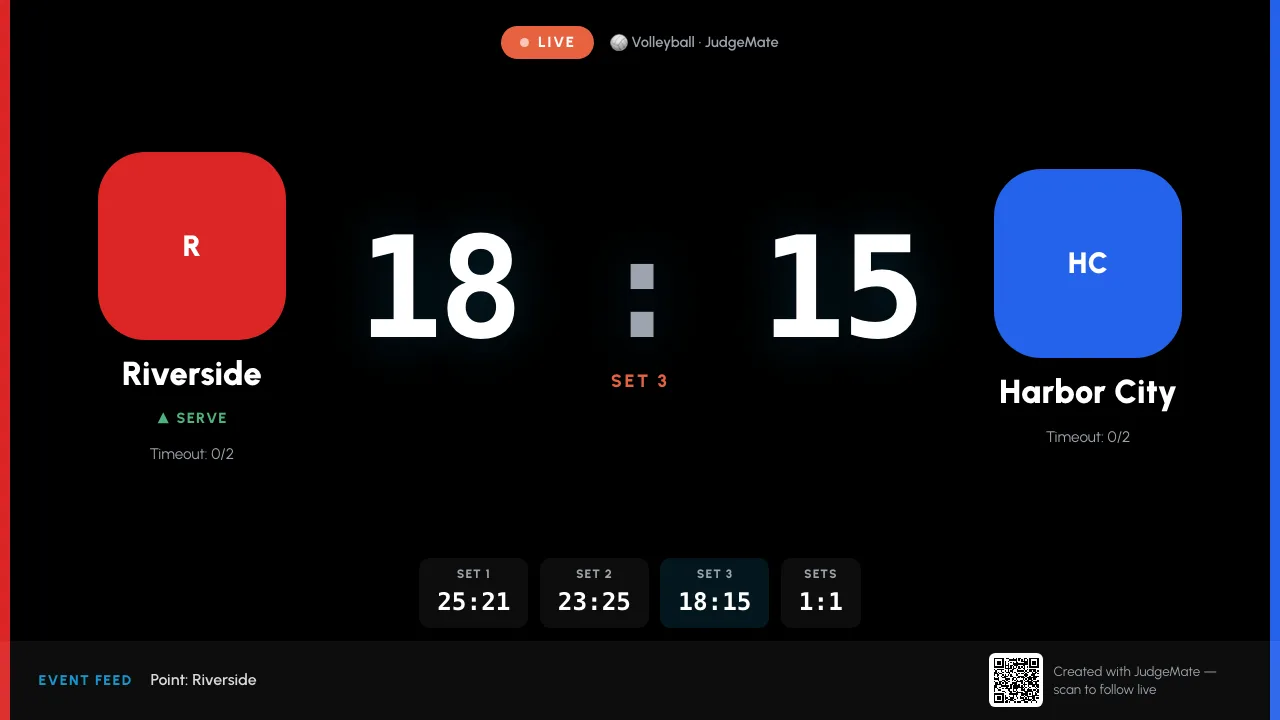
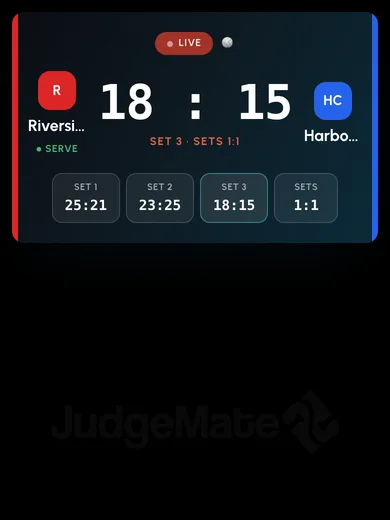
JudgeMate for hockey games
Arena-style scoreboard, run from a phone
One phone controls the clock, score, and penalty box. A shared link shows the live view on any screen.
No sign-up
Open JudgeMate, pick ice hockey, enter the team names, drop the puck. No account, no fees. The admin works from a phone; fans and coaches open the spectator link or QR code on any device.
Period countdown clock
Three regulation periods run 20:00 to 0:00. Overtime runs a 5:00 countdown. Start, stop, and adjust with one tap — built for rec games where clock management is on the bench, not an operator.
Live penalty timers
Minor 2:00, major 5:00, misconduct 10:00. Each penalty ticks down on the spectator view so everyone sees exactly when the player returns. Multiple penalties display side by side.
Shootout mode
When a game goes to a shootout, the scoreboard switches out the clock and tracks round-by-round attempts. Standard three rounds with sudden death support.
Big-screen display
High-contrast layout, large fonts. Plug a laptop into a rink TV or projector and the spectator view scales — readable from the stands, the bench, and the box.
Fans follow on the link
Parents, tournament organizers, and coaches see the live score, clock, period, and penalty timers on their phones. One QR code per rink for multi-rink tournaments.
Match-day polls
Open quick polls during the match — MVP, best save, player of the match. Fans vote from their phones, the leaderboard moves in real time, and the archive shows what the crowd thought after every game.
1 more feature
Match-day polls
Open quick polls during the match — MVP, best save, player of the match. Fans vote from their phones, the leaderboard moves in real time, and the archive shows what the crowd thought after every game.
Ice Hockey Competition Formats, Officiating & Rules
Competition Formats
Standard 5v5 Hockey (Three Periods of 20 Minutes)The standard format of ice hockey features two teams of six players on the ice — five skaters (typically three forwards and two defensemen) plus one goaltender. Games consist of three 20-minute periods with 15-18 minute intermissions between periods. The clock counts down from 20:00 to 0:00, stopping on every whistle (dead-ball time), so a 60-minute game of playing time typically takes 2 to 2.5 hours of real time.
The standard format of ice hockey features two teams of six players on the ice — five skaters (typically three forwards and two defensemen) plus one goaltender. Games consist of three 20-minute periods with 15-18 minute intermissions between periods. The clock counts down from 20:00 to 0:00, stopping on every whistle (dead-ball time), so a 60-minute game of playing time typically takes 2 to 2.5 hours of real time.
The playing surface is a standard ice rink (200 feet x 85 feet in North America, or 60m x 30m internationally). The rink has three zones divided by the blue lines (offensive zone, neutral zone, defensive zone), with a red center line splitting the ice in half. Teams score by shooting the puck into the opponent's net (4 feet high x 6 feet wide).
Teams dress 18-20 players per game (typically 12 forwards, 6-8 defensemen, and 2 goaltenders) and rotate lines every 30-60 seconds during play. Line changes can occur on the fly (during play) or during stoppages. JudgeMate's Free Scoreboard covers the full standard format with countdown timers for all three periods.
Overtime Rules (NHL and IIHF 3v3)When a game is tied after regulation, overtime rules vary by league and competition. In the NHL regular season, overtime is a single 5-minute period played 3-on-3 (three skaters per side plus goaltenders), creating wide-open, end-to-end hockey with frequent scoring chances. The first team to score wins (sudden death). If no goal is scored in the 5-minute overtime, the game proceeds to a shootout.
When a game is tied after regulation, overtime rules vary by league and competition. In the NHL regular season, overtime is a single 5-minute period played 3-on-3 (three skaters per side plus goaltenders), creating wide-open, end-to-end hockey with frequent scoring chances. The first team to score wins (sudden death). If no goal is scored in the 5-minute overtime, the game proceeds to a shootout.
In IIHF international competition (including World Championships and Olympics), overtime is also played 3-on-3 (rules as of 2026): 5 minutes of sudden death in the preliminary round, followed by a shootout with five shooters per team; 10 minutes in the quarter-finals, semi-finals and bronze medal game, followed by a shootout; and in the gold medal game, 20-minute sudden-death periods until someone scores, with no shootout. NHL playoff overtime is played with full 5-on-5 rosters in 20-minute sudden-death periods with no shootout — games continue until someone scores, regardless of how long it takes (the longest NHL playoff game lasted 176 minutes and 30 seconds of playing time in 1936).
JudgeMate's Free Scoreboard handles overtime with a 5:00 countdown timer, configurable for different formats. The period indicator clearly shows OT status so spectators always know where the game stands.
Shootout (Penalty Shots)When overtime fails to produce a winner (in regular-season or round-robin formats), a shootout decides the game. Each team selects three shooters who take turns attempting penalty shots — skating in alone from center ice against the opposing goaltender. The team with more goals after three rounds wins.
When overtime fails to produce a winner (in regular-season or round-robin formats), a shootout decides the game. Each team selects three shooters who take turns attempting penalty shots — skating in alone from center ice against the opposing goaltender. The team with more goals after three rounds wins.
If the shootout is tied after three rounds, it continues in sudden-death format — each team sends one shooter, and if one scores and the other doesn't, the game is over. Shooters cannot repeat until all eligible players have shot (in practice, this rule rarely comes into play). The shootout is a high-drama, skill-based tiebreaker that showcases the individual duel between shooter and goaltender.
In JudgeMate's Free Scoreboard, shootout mode removes the game clock entirely, as no clock is needed during penalty shots. The scoreboard focuses on tracking each round's results clearly, making it easy for spectators to follow the shootout drama in real time.
The Officiating System in Ice Hockey
A crew of four on-ice officials runs ice hockey games: two referees and two linesmen. The referees (identifiable by orange armbands) have full authority to call all penalties, award goals, and manage the game. The linesmen are primarily responsible for calling offside and icing violations, conducting faceoffs, and breaking up altercations, though they can also report certain penalties to the referees.
The four-official system (two referees, two linesmen) is standard at all top-level and most competitive amateur levels. The NHL adopted it in 1998-99, replacing the previous one-referee, two-linesman system. The two-referee system covers the fast-paced action better, with one referee typically positioned near the play and the other giving a wider-angle view.
- Penalty System
- Minor penalties (2 minutes — tripping, hooking, slashing, interference, holding), double minor penalties (4 minutes, typically high-sticking drawing blood), major penalties (5 minutes, fighting, boarding, checking from behind), misconduct penalties (10 minutes, served in full, team stays at full strength), and game misconducts (ejection from the game). During minor and double minor penalties, the penalized team plays shorthanded.
- Offside Rule
- A player is offside if they enter the offensive zone (cross the blue line) before the puck. If an offside player touches the puck, play is stopped and a faceoff is held in the neutral zone. The NHL also allows coaches to challenge goals for a missed offside leading to the scoring play.
- Icing
- Occurs when a team shoots the puck from their side of the center red line across the opposing team's goal line without it being touched. Results in a faceoff in the offending team's defensive zone. The offending team cannot make a line change. Icing is waved off if the team is shorthanded (on the penalty kill), if the goaltender plays the puck, or if an opposing player could have reasonably played it.
- Video Review
- The NHL Situation Room (or the on-ice officials in other leagues) reviews every goal for validity. Coaches can challenge goals for offside or goaltender interference. In the NHL, failed challenges result in a minor penalty for delay of game. The review system has significantly improved goal-scoring accuracy and fairness.
Current hockey officiating technology includes video replay systems with multiple camera angles, puck and player tracking sensors (NHL's hockey tracking system uses 14-16 cameras per arena plus chips in pucks and jerseys), and real-time communication between on-ice officials and the league's Situation Room. Goal review technology examines whether the puck fully crossed the goal line, whether the play was offside, and whether there was goaltender interference — all within seconds of the goal being scored.
Guides and tools about Ice Hockey
- How Is Ice Hockey Scored?How ice hockey scoring works: goals, assists, 3-period structure, overtime, and shootouts. Covers NHL, IIHF, and Olympic rule differences for new fans.
- How to Referee Ice HockeyIce hockey officiating: referee vs linesman roles, penalty signals, offside, icing, faceoffs, video review, and the certification path, with worked examples.
- How to Use a Live Ice Hockey ScoreboardFree ice hockey scoreboard: countdown clock, penalty timers, overtime, shootout mode, and spectator display via QR code. Run any match from your phone, no app.
- What are the positions in ice hockey and what does each player do?Ice hockey positions explained: what a center, left and right wing, two defensemen and the goaltender each do, plus how forward lines and defense pairs work in a game.
- What are the penalties in ice hockey, and how long is each one?Ice hockey penalties explained: minor (2 min), double minor (4), major (5), misconduct (10), match, and the penalty shot — what each call means and how long.
- What are power play and penalty kill in hockey?What is a power play in hockey? Learn special teams — 5-on-4, 5-on-3, penalty kill rules, short-handed goals, coincidental minors and 3-on-3 overtime.
Show all (10)
- What are the dimensions of an ice hockey rink?NHL rinks measure 200 ft x 85 ft; IIHF Olympic ice is 60 m x 30 m and wider. Compare blue lines, the goal crease, faceoff dots and rink markings here.
- What do hockey stats mean — points, plus/minus, and save percentage?Hockey stats explained: goals, assists, points, plus/minus, penalty minutes, save percentage, GAA, and advanced metrics like Corsi and Fenwick, with examples.
- Run a season league
- Free tournament bracket generator
Frequently Asked Questions About Ice Hockey & JudgeMate's Free Scoreboard
Primary Sources
- IIHF Rule Book 2025–2029 — IIHF
- NHL Official Rules — NHL
More about Ice Hockey
6 sections · Arena-style scoreboard for any rink · The World's Biggest Ice Hockey Competitions · Ice Hockey's Greatest Players · Key Ice Hockey Equipment · Ice Hockey Trends & Modern Developments · The History and Evolution of Ice Hockey
More about Ice Hockey
6 sections · Arena-style scoreboard for any rink · The World's Biggest Ice Hockey Competitions · Ice Hockey's Greatest Players · Key Ice Hockey Equipment · Ice Hockey Trends & Modern Developments · The History and Evolution of Ice Hockey
Arena-style scoreboard for any rink
Ice hockey moves fast. Goals, penalties, line changes, clock stoppages — a good scoreboard keeps all of it straight, and most community rinks don't have one.
JudgeMate replaces the whiteboard with a scoreboard run from one phone. 20:00 period countdowns, 5:00 overtime, live penalty timers that count down on the spectator view — minor 2:00, major 5:00, misconduct 10:00. Multiple penalties show side by side, the way a real penalty box does.
Share the link or QR code. Rink TV, projector, coach's tablet, or a parent's phone — everyone sees the same clock and the same score.
The World's Biggest Ice Hockey Competitions
Ice hockey's competitive landscape spans top-level leagues, international tournaments, and the Olympic Games. From the intensity of the Stanley Cup Playoffs to the national pride of the World Championship, these are the pinnacle events that define the sport.
NHL Stanley Cup Playoffs
The Stanley Cup is the oldest championship trophy in North American sport, first awarded in 1893 and competed for exclusively by NHL teams since 1926. The Stanley Cup Playoffs are a grueling two-month, four-round tournament in which 16 teams compete in best-of-seven series to hoist the Cup. The Playoffs are renowned for their intensity — players compete through injuries, games go to multiple overtimes, and the atmosphere in arenas reaches a fever pitch. The Montreal Canadiens hold the record with 24 Stanley Cup championships, followed by the Toronto Maple Leafs with 13. The tradition of the captain hoisting the Cup and the team drinking from it makes the Stanley Cup the most iconic trophy in major sports.
IIHF World Championship
The IIHF World Championship is the leading annual international ice hockey tournament, organized by the International Ice Hockey Federation since 1920. Held every May (typically in a European host country), the tournament features 16 teams in the top division competing in a round-robin format followed by quarterfinals, semifinals, and medal games. Canada and Russia (including the Soviet Union era) lead the all-time medal count, but the tournament has become increasingly competitive with nations like Finland, Sweden, Czech Republic, Switzerland, and the United States regularly contending for gold. The World Championship serves as the main international competition in non-Olympic years.
Olympic Ice Hockey Tournament
Ice hockey at the Winter Olympics is one of the Games' marquee events, combining national pride with top competition. The men's tournament has been part of the Olympics since 1920, and the women's tournament was added in 1998. Olympic hockey has produced iconic moments — the Soviet Union's dynasty, the 1980 Miracle on Ice, Canada's golden goal by Sidney Crosby in overtime at the 2010 Vancouver Games. When NHL players participate, the Olympic tournament features the world's absolute best players competing for their countries, creating a level of intensity and emotion that no club competition can match. The women's tournament has been pivotal in growing the women's game globally.
IIHF World Junior Championship
The World Junior Championship (WJC) is the leading under-20 international ice hockey tournament, held annually during the holiday season (late December to early January). The tournament is a showcase for the next generation of hockey talent — nearly every NHL star played in the World Juniors, and draft-eligible players use the tournament to boost their stock. Canada and the tournament hold a special relationship, with the WJC drawing massive television audiences and passionate fan support whenever Canada hosts. The tournament features the same round-robin and knockout format as the senior World Championship and has become a beloved holiday tradition for hockey fans worldwide.
Ice Hockey's Greatest Players
A line of exceptional athletes has shaped ice hockey, with skill, vision, and determination that defined eras and inspired generations. From the frozen ponds of Canada to the grand arenas of the NHL and international competition, these players elevated the sport to an art form. Here are the all-time legends and the current stars dominating the ice today.
All-Time Legends
Wayne Gretzky
Known as "The Great One," Wayne Gretzky holds over 60 NHL records, including 2,857 career points — a mark so far beyond anyone else that he would still be the all-time points leader even if he had never scored a single goal. His vision, playmaking ability, and hockey IQ reshaped the sport and brought the NHL to new markets across the United States.
Bobby Orr
Bobby Orr redefined what a defenseman could be, becoming the first blueliner to lead the NHL in scoring. He won 8 consecutive Norris Trophies (1968-1975) and captured the Conn Smythe Trophy twice. His iconic flying goal to win the 1970 Stanley Cup remains one of the most famous images in sports history.
Gordie Howe
"Mr. Hockey" played top-level hockey across five decades, from 1946 to 1980, combining elite skill with legendary toughness. Gordie Howe held the NHL career goals record (801) until Gretzky surpassed it and was known for the "Gordie Howe Hat Trick" — a goal, an assist, and a fight in the same game.
Mario Lemieux
Mario Lemieux overcame Hodgkin's lymphoma and chronic back problems to become one of the most gifted players ever to lace up skates. "Super Mario" scored 1,723 points in just 915 games, won two Stanley Cups with the Pittsburgh Penguins, and later saved the franchise as owner. His combination of size, skill, and vision stood alone.
Jaromír Jágr
The Czech-born Jaromír Jágr is second on the NHL's all-time points list (1,921 points, as of 2026), the most by any European player, and played professionally until age 51. He won two Stanley Cups with Pittsburgh, five Art Ross Trophies as the league's top scorer, and represented Czech Republic in winning the 1998 Olympic gold medal in Nagano — one of the most celebrated moments in Czech sports history.
Dominik Hašek
"The Dominator" reshaped goaltending with his unorthodox, acrobatic style. Dominik Hašek won six Vezina Trophies as the NHL's best goaltender and two Hart Trophies as league MVP — the only goaltender to win the Hart in back-to-back seasons. He backstopped the Czech Republic to Olympic gold in 1998, delivering one of the greatest goaltending performances in tournament history.
Valeri Kharlamov
Valeri Kharlamov was the Soviet Union's most brilliant forward, a dazzling skater and stickhandler who starred in the legendary 1972 Summit Series against Canada. He won 11 Soviet league titles and two Olympic golds, and his speed and creativity influenced generations of Russian hockey players. His tragic death in a car accident at age 33 cut short what many consider the most talented career in Soviet hockey history.
Maurice Richard
"The Rocket" was hockey's first true superstar and a cultural icon in Quebec. Maurice Richard became the first player to score 50 goals in 50 games (1944-45) and the first to reach 500 career goals. His fierce competitiveness and scoring prowess made him a symbol of French-Canadian pride, and the famous "Richard Riot" of 1955 demonstrated his cultural significance beyond the sport.
Current Stars
Connor McDavid
Widely regarded as the best player in the world, Connor McDavid's skating speed and offensive creativity stand alone in today's NHL. The Edmonton Oilers captain has won multiple Art Ross Trophies and Hart Trophies, and his ability to accelerate through the neutral zone and create scoring chances at full speed makes him the most electrifying player of his generation.
Nathan MacKinnon
Nathan MacKinnon combines explosive speed with elite playmaking, driving the Colorado Avalanche to the 2022 Stanley Cup championship. His relentless two-way game and physical play make him one of the most complete forwards in hockey, capable of dominating games in every situation.
Auston Matthews
Auston Matthews is a generational goal scorer who scored 60 goals in 2021-22, the first 60-goal season since Steven Stamkos in 2011-12, and 69 goals in 2023-24, the most in an NHL season since Mario Lemieux in 1995-96. The California-born center has brought American hockey talent to the forefront and his lethal release and positioning around the net make him the NHL's most dangerous pure sniper.
Leon Draisaitl
The German-born Leon Draisaitl is one of the most productive centers in the NHL, winning the Hart Trophy and Art Ross Trophy in 2020. His exceptional vision, heavy shot, and ability to dominate on the power play make him a perennial scoring leader. Draisaitl has elevated Germany's hockey profile on the world stage.
Nikita Kucherov
Russian winger Nikita Kucherov is a masterful playmaker and scorer who led the Tampa Bay Lightning to back-to-back Stanley Cup championships in 2020 and 2021. His 128-point season in 2018-19 won the Hart Trophy, and his vision, puck-handling, and ability to create offense in tight spaces are among the best in the game.
Cale Makar
Cale Makar has redefined the role of the defenseman, winning the Norris Trophy and Conn Smythe Trophy before turning 24. His elite skating, offensive instincts, and defensive reliability for the Colorado Avalanche draw comparisons to Bobby Orr. Makar's ability to rush the puck end-to-end and quarterback the power play makes him the most dynamic blueliner in the game.
Igor Shesterkin
Igor Shesterkin has established himself as the NHL's top goaltender, winning the Vezina Trophy and consistently posting elite save percentages for the New York Rangers. The Russian netminder's quick reflexes, positioning, and ability to steal games single-handedly have drawn comparisons to Dominik Hašek. He is widely considered the most valuable goaltender in the sport today.
David Pastrňák
Czech winger David Pastrňák combines a lethal one-timer with creative offensive flair, making him one of the NHL's most exciting players. A consistent 40+ goal scorer for the Boston Bruins, Pastrňák's ability to find open ice and finish with precision from any angle has made him a fan favorite and one of the league's most marketable stars.
Kirill Kaprizov
Kirill Kaprizov burst onto the NHL scene winning the Calder Trophy as Rookie of the Year in 2021 and has quickly become the Minnesota Wild's franchise player. The Russian winger's combination of speed, creativity, and finishing ability has transformed the Wild into a contender. His highlight-reel goals and dynamic playmaking make him one of the most exciting players in the league.
Sidney Crosby
"Sid the Kid" has been hockey's gold standard for two decades, captaining the Pittsburgh Penguins to three Stanley Cup championships (2009, 2016, 2017). Sidney Crosby's combination of elite skill, work ethic, and leadership stands alone among his generation. His Olympic golden goal in overtime at the 2010 Vancouver Games is one of the most iconic moments in Canadian sports history.
Key Ice Hockey Equipment
Ice hockey requires specialized equipment designed for a game played at high speed on a sheet of ice, where body contact is a fundamental part of play. From the stick and puck to the heavily padded goaltender gear, every piece of equipment serves a critical function for performance, protection, and safety. Understanding hockey equipment is key for players at all levels — from beginners stepping onto the ice for the first time to experienced athletes competing in organized leagues.
Hockey Stick & Puck
The hockey stick is a player's primary tool for shooting, passing, stickhandling, and defense. Current sticks are made from composite materials (carbon fiber), offering a lighter weight and more consistent flex than the traditional wooden sticks of earlier eras. Sticks vary in flex rating, blade curve, and length depending on player position and preference. The puck is a vulcanized rubber disc weighing 6 ounces (170 grams) and 1 inch (2.54 cm) thick, designed to slide smoothly on ice and withstand shots exceeding 100 mph (160 km/h).
Ice Skates
Hockey skates deliver speed, agility, and power transfer. The boot is stiff and protective, with a reinforced shell around the ankle and foot. The blade is a thin, curved piece of steel attached to a holder on the boot's sole — sharpened with a hollow grind that creates two edges for precise turning and stopping. Player skates prioritize mobility, while goaltender skates have a flatter blade and a wider boot to aid lateral movement and stability in the crease.
Helmet & Visor
The helmet is the most critical piece of protective equipment, mandatory at all levels of organized hockey. Current helmets feature multi-density foam padding and a hard outer shell designed to absorb and distribute impact forces. A visor or full cage protects the face — full cages are required in youth and amateur hockey, while NHL players wear half-visors. Goaltenders wear specialized masks with a cage and reinforced shell built to withstand direct puck impacts at high velocity.
Protective Pads & Gloves
Hockey players wear extensive padding (shoulder pads, elbow pads, shin guards, and padded pants/breezers) to protect against puck impacts, stick contact, falls, and body checks. Gloves protect the hands while allowing full dexterity for stickhandling and shooting. The equipment must balance maximum protection with freedom of movement — current designs use lightweight, high-impact foams and ergonomic shaping to achieve both. A mouthguard and athletic cup are also standard protective items.
Goaltender Equipment
Goaltender equipment is the most specialized in the sport, designed to cover as much of the net as possible while allowing the athletic movements needed to make saves. The kit includes oversized leg pads (up to 11 inches wide in the NHL), a blocker (a rectangular pad on the stick hand), a trapper (a catching glove), and a chest and arm protector. Goaltender sticks have a wider blade and shaft. All goaltender equipment is subject to strict size regulations by the NHL and IIHF to maintain competitive balance.
Ice Hockey Trends & Modern Developments
Ice hockey is undergoing a period of rapid transformation. From data-driven coaching to the expansion of the women's game, the sport is evolving at every level — top-league, amateur, and grassroots. These are the most significant trends shaping the future of hockey.
Player Tracking & Analytics
The NHL's player and puck tracking system, fully deployed since the 2021-22 season, uses sensors in pucks and player jersey patches combined with arena cameras to capture real-time data on skating speed, shot velocity, distance covered, and positioning. This has fueled an analytics revolution — teams now employ data science departments to optimize line combinations, evaluate prospects, and develop game strategies. Detailed metrics like expected goals (xG), Corsi, and zone entries have become standard tools for coaches, scouts, and media. At the grassroots level, tools like JudgeMate's Free Scoreboard bring a taste of this data-driven approach to amateur hockey by providing real-time digital score and penalty tracking accessible from any device.
The Speed Era (Post-2005 Rules)
The rule changes implemented after the 2004-05 NHL lockout fundamentally transformed the sport. Eliminating the two-line pass, reducing goaltender puck-handling zones, enforcing obstruction penalties, and introducing the shootout created a faster, higher-scoring, and more entertaining game. Today's NHL rewards skating speed, creative playmaking, and offensive skill over the clutch-and-grab, trap-style hockey that dominated the late 1990s. Average goals per game have risen steadily, and players like Connor McDavid routinely reach skating speeds over 40 km/h (25 mph) during games, making today's hockey the fastest era in the sport's history.
Goaltender Evolution
Current goaltending has been reshaped by the butterfly technique and its variations, where goaltenders drop to their knees and spread their pads to cover the lower portion of the net. Equipment technology (lighter, larger, and more precisely fitted pads) combined with detailed positioning systems, makes today's goaltenders more efficient than ever. Save percentages have risen from the .880s in the 1980s to consistently above .910 in the current era. Goaltender coaching has become a specialized discipline, with video analysis, angle management drills, and post-integration techniques becoming standard at every level of the sport.
Video Review Expansion
Video review technology in hockey has expanded dramatically from its origins as a simple goal-line review system. Today, the NHL's Situation Room in Toronto monitors every game in real time, reviewing goals for validity, assessing potential offside violations, evaluating goaltender interference, and examining major penalties. Coaches can challenge calls, and reviews are typically completed within 60-90 seconds. The IIHF and other international bodies have adopted similar systems for major tournaments. This technology has significantly improved the accuracy and fairness of officiating, though debates about the boundaries of reviewable plays continue to shape the sport's rules.
Women's Hockey & PWHL
Women's ice hockey is experiencing an unprecedented era of growth and visibility. The launch of the Professional Women's Hockey League (PWHL) in 2024, with teams in six North American cities, stable ownership and a league-employed player model, represents a historic milestone. Average PWHL attendance has exceeded expectations, and broadcast deals have brought women's hockey to mainstream audiences. On the international stage, the Canada-USA rivalry remains the sport's marquee matchup, consistently producing dramatic gold medal games at the Olympics and World Championships. Growing investment in youth girls' hockey programs worldwide is building the pipeline for future generations of talent.
International Talent Development
The NHL has become a truly global league, with players from over 20 countries on active rosters. While Canada and the United States still produce the most NHL players, European nations, particularly Sweden, Finland, Russia, and Czech Republic, have become major talent pipelines. Germany, Switzerland, Latvia, and Denmark have also emerged as developing hockey nations, producing NHL stars and competitive national teams. International scouting networks, improved youth development systems in non-traditional markets, and the visibility of the IIHF World Championships and Olympics have all contributed to this global talent expansion. For grassroots programs in emerging hockey nations, tools like JudgeMate's Free Scoreboard help organize and professionalize local competitions without requiring expensive arena infrastructure.
The History and Evolution of Ice Hockey
Origins on Frozen Ponds: Montreal and the Birth of Hockey (1870s)
While stick-and-ball games on ice have been played for centuries across northern Europe and North America, organized ice hockey was born in Montreal, Canada, in the 1870s. On March 3, 1875, the first organized indoor hockey game was played at the Victoria Skating Rink in Montreal, with teams of nine players using a flat wooden puck instead of a ball. James Creighton, a McGill University student from Nova Scotia, is credited with organizing the match and establishing the first set of rules.
By the 1880s, hockey had spread across Canadian universities and athletic clubs. The Montreal Winter Carnival featured hockey tournaments that attracted growing crowds. In 1886, the Amateur Hockey Association of Canada was formed, establishing the first organized league. Lord Stanley of Preston, Canada's Governor General, was so captivated by the sport that in 1892 he purchased a silver bowl for 10 guineas, the Dominion Hockey Challenge Cup, now known as the Stanley Cup and the oldest North American sports trophy.
The early game was rough, chaotic, and played with minimal protective equipment. Forward passing was not allowed (similar to rugby), teams played with seven skaters plus a goaltender, and the puck was often a frozen piece of cow dung or a chunk of wood. But the speed, physicality, and skill of the sport captivated audiences, and hockey's popularity exploded across Canada by the turn of the century.
The NHL and Professional Hockey (1917-1970)
The National Hockey League was founded on November 26, 1917, in Montreal, replacing the defunct National Hockey Association. The original four teams (the Montreal Canadiens, Montreal Wanderers, Ottawa Senators and Toronto Arenas, later the Maple Leafs) established a league that would grow into the flagship hockey organization in the world.
The NHL's early decades were defined by the Original Six era (1942-1967), when just six teams, Montreal, Toronto, Boston, Chicago, Detroit, and New York Rangers, competed for the Stanley Cup. This period produced hockey's first true legends: Maurice "Rocket" Richard, who became the first player to score 50 goals in a season; Gordie Howe, whose combination of skill and toughness earned him the nickname "Mr. Hockey"; and Bobby Orr, whose major offensive play from the defense position changed the game forever.
The Great Expansion of 1967 doubled the league from 6 to 12 teams, bringing hockey to new American markets. Further expansion through the 1970s, 1980s, and 1990s, along with mergers with the World Hockey Association, grew the NHL to 32 teams by 2021. Wayne Gretzky's arrival in the late 1970s elevated hockey's profile globally, with "The Great One" rewriting every offensive record and bringing the sport to non-traditional markets like Los Angeles.
Hockey on the World Stage: Olympics and International Competition
Ice hockey has been part of the Olympic Games since 1920 (Summer Olympics in Antwerp) and has been a Winter Olympics staple since the first Winter Games in 1924 in Chamonix. For decades, the Olympics were dominated by Canada and the Soviet Union, whose rivalry produced some of the most dramatic moments in sports history.
The 1980 "Miracle on Ice", when the United States' team of college players defeated the heavily favored Soviet Union 4-3 at the Lake Placid Olympics, remains one of the greatest upsets in sports history. The Soviet hockey program, which won gold in 7 of 9 Olympics between 1956 and 1988, changed the sport with its emphasis on passing, skating, and team play over the North American preference for physical, dump-and-chase hockey.
Women's ice hockey was added to the Olympic program in 1998 at the Nagano Games. Canada and the United States have dominated the women's tournament, meeting in the gold medal game at 7 of the 8 Olympics from 1998 to 2026. The rivalry has elevated women's hockey globally and driven the creation of top-level women's leagues. The IIHF World Championship, held as a separate tournament since 1930, remains the top-level international tournament outside the Olympics, with nations like Finland, Sweden, Czech Republic, and Slovakia consistently challenging the traditional powers.
The Modern Era: Analytics, Video Review, and the Speed Game (2000-Present)
The 21st century has transformed ice hockey through technology and analytics. Video review, first introduced for goal reviews in the 1991 Stanley Cup Playoffs, has expanded to cover goaltender interference, offside challenges, and major penalties. The NHL's Situation Room in Toronto reviews every goal scored in real time, ensuring accuracy that was impossible in earlier eras.
Player tracking technology, fully implemented in the NHL starting in the 2021-22 season, uses chips in pucks and player jerseys to capture real-time data on skating speed, shot velocity, distance traveled, and positioning. This data has fueled an analytics revolution, with teams employing data scientists to optimize line combinations, power play strategies, and draft decisions. Metrics like expected goals (xG), Corsi, and Fenwick have become standard vocabulary for coaches and fans alike.
On the ice, the game has shifted toward speed and skill. Rule changes after the 2004-05 lockout (eliminating the two-line pass, reducing goaltender puck-handling zones and strictly enforcing obstruction penalties) opened up the game dramatically. Current hockey features faster skating, more creative playmaking, and higher-scoring games than the defensive, clutch-and-grab era of the late 1990s. JudgeMate's Free Scoreboard brings this same current approach to score tracking at every level. Real-time, precise, and accessible from any device.
Start a Free Hockey Scoreboard
Beer league, youth tournament, or a pickup game that deserves a proper scoreboard — JudgeMate runs it. Free, instant, built for hockey.
Run your next hockey game with JudgeMate — live score, penalty box, and a link you can share with the whole rink.